Moving Furniture Through a Narrow Balcony in Jeddah: Measure, Decide, Lift Safely
When a sofa will not fit through the front door and the lift is too small for a tall wardrobe, the balcony often looks like the only way out. A narrow balcony, though, raises its own questions: is the clear opening wide enough, can the railing come off, and is a crane safer than more dismantling? This guide walks expat tenants and homeowners in Jeddah through measuring the balcony, comparing options and clearing it with the landlord or building management before anything is lifted.
Balcony measuring · Furniture lifting crane · Dismantling & assembly · Building coordination · Within Jeddah only
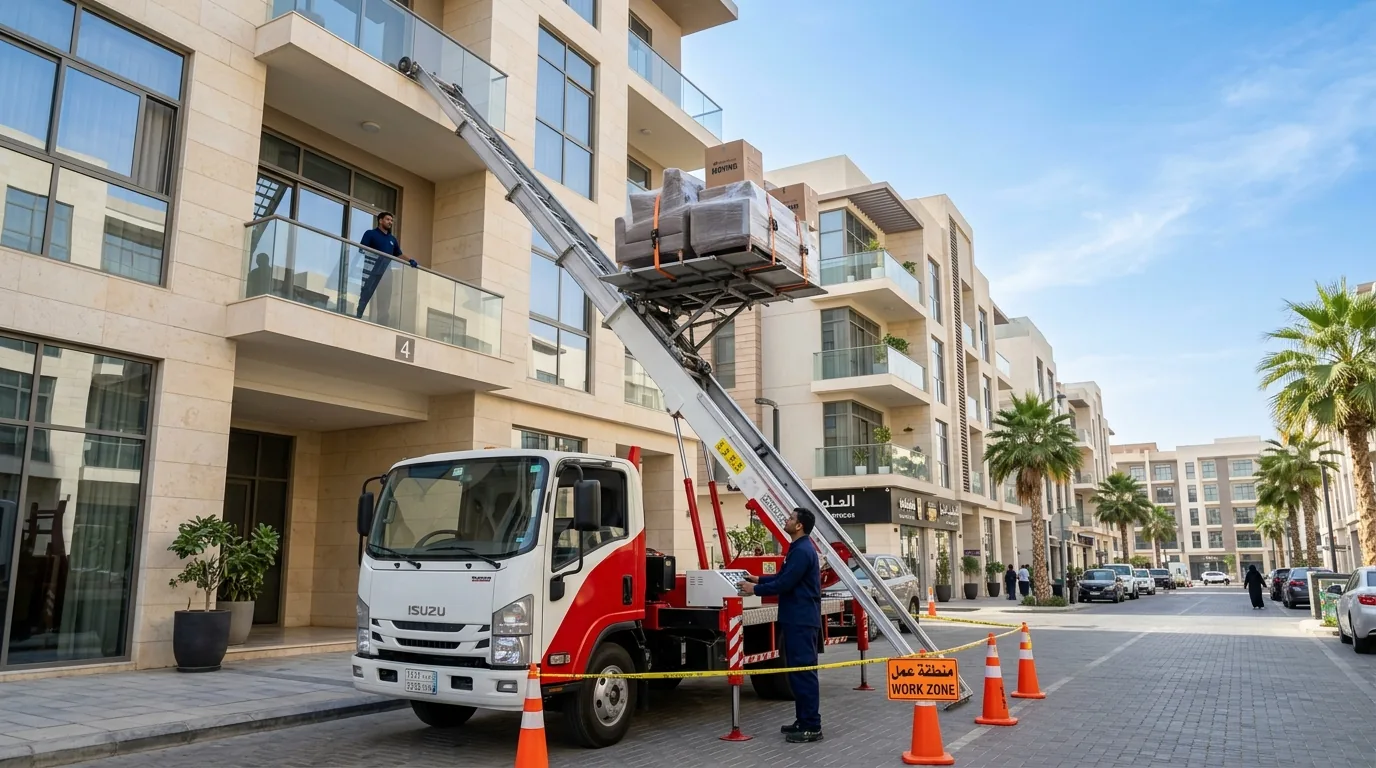
When the balcony becomes the exit
The balcony usually comes into play in three situations. The first is a large item that does not come apart, such as a sofa with a one-piece frame or a stiff orthopaedic mattress. The second is a walk-up building with tight stair turns. The third is a lift too small for a tall wardrobe or a double-door fridge.
Forcing those items through doors and stairwells is how walls get gouged and frames crack. But not every balcony is usable: some are smaller than the item, have glass balustrades that cannot be removed, or overlook a lane where no crane can park.
If your problem is really the doorway or staircase, start with our guide to narrow doorways and spiral stairs; the fix may be simpler than you think.
The three measurements that decide everything
First, the clear opening: the gap between side walls or pillars, not the overall balcony width. Second, the railing or parapet height from the balcony floor, because the item must go over it unless it can be removed. Third, the depth from the living-room door to the edge, which tells us whether the item can turn inside the balcony before it leaves.
Also measure the balcony door. Many Jeddah apartments have sliding balcony doors narrower than the front door, which exposes the problem early.
Measure the item in all three dimensions with its wrapping on; blankets and film add a few centimetres that can make the difference. For corridors and lifts, see measuring lifts and hallways before moving.
Railing types and what they mean
| Barrier | Removable? | Impact on the move |
|---|---|---|
| Bolted steel railing | Sometimes, with landlord approval | Temporary removal widens the gap; must be refixed securely |
| Welded steel railing | Usually not | Item must clear the top, so the crane reach matters |
| Framed tempered glass | Not recommended | Fragile; protected with layers and cleared carefully |
| Low concrete parapet | No | Strong and fixed; height is the only obstacle |
| Balcony enclosed with aluminium windows | Window sashes only | One or two sashes can be removed to open the gap |
Many Jeddah residents enclose balconies with aluminium windows against dust and heat. That is rarely a dead end, since sashes can usually be removed and refitted, but agree it with the landlord first.
Decision flow: crane, dismantle or stairs?
The balcony is not the first choice. It comes after confirming the item cannot take the normal route and cannot be safely dismantled, which saves you crane costs when they are not needed.
Once we reach the balcony option, we judge it on the three measurements and on whether a crane can stand in the street below.
Send a photo of your balcony and its opening width on WhatsApp and we will tell you if a crane can use it.
How a furniture crane works with a tight balcony
A furniture lifting crane is a truck-mounted ladder or boom that rises at an angle to the balcony edge, with a platform that carries the item up or down. With a narrow balcony, precision matters: the platform has to stop exactly at the edge without rubbing the railing.
One crew member stands on the balcony to receive or release the item, while the operator below controls speed and angle. Items are strapped to the platform before lifting and released only once they are inside.
Service details are on our furniture lifting crane page; this guide focuses on the balcony itself as the route.
Why we avoid ropes for heavy items
Lowering furniture by rope is an old shortcut. It may work for something very light from a low first floor, but with heavy items or higher floors the risks are real: the load swings into the facade, knots slip, or someone below gets hurt.
A rope gives no directional control, and wind, especially in districts near the sea, can push an item into windows or wall-mounted AC units. Even a short drop usually means a damaged piece.
We prefer extra dismantling or a crane with a fixed platform. Ropes may serve as a guide line alongside a crane, never as the main lifting method.
When extra dismantling beats the balcony
Many pieces that seem solid can be partly taken apart by an experienced carpenter. Sofa legs and arms come off, headboards detach, wardrobes split into modules. Often that is enough to use the stairs or lift instead.
Dismantling is the better choice when the balcony is too narrow even with the railing removed, when the street cannot take a crane, or when management will not allow use of the facade. It is also quieter for neighbours.
See furniture dismantling and assembly in Jeddah for what can be taken apart safely, and moving furniture that cannot be dismantled for the cases where it cannot.
Comparing the three methods
| Criterion | Dismantle and carry inside | Crane via balcony | Manual rope |
|---|---|---|---|
| Heavy items | Yes, if they come apart | Yes | Not advised |
| Needs street space | No | Yes | Partly |
| Building approval | Usually not | Usually yes | Usually yes |
| Control of the load | Full | High, on a platform | Poor |
| Wind sensitivity | None | Moderate | High |
| Time | Adds carpenter hours | Fast once set up | Slow, unpredictable |
There are no figures here because cost depends on floor, item size and count. The point is that the choice depends on conditions, not price alone, and ropes come last.
Landlord, tenancy and building management
For tenants, the balcony belongs to the landlord, so get written approval before anyone removes a railing or window sash. A short message with photos of what will be removed and how it will be refitted protects your deposit when you hand the flat back.
Gated compounds and towers usually have written rules for moving: approved time slots, registration of the moving company and sometimes a ban on facade lifting. Our guide to building and compound approvals in Jeddah explains what to ask.
Tell the neighbours below a day ahead. Ask them to clear their balcony and keep windows shut during the lift; it avoids disputes and protects their belongings.
Is there room for a crane below?
A crane needs space in front of or beside the building for the truck and the ladder angle. If the balcony overlooks a narrow lane or a packed car park, the crane may not work from that side even if the balcony itself is fine.
Check for power cables, trees, shop signs and car shades in the ladder’s path. Any of these can change the angle and force us to use another balcony or a large window.
Send two photos: one from the street looking up at the balcony, and one from the balcony looking down at the street. They usually let us judge feasibility before any visit.
Jeddah weather and balcony work
Outdoor lifting is more weather-sensitive than indoor carrying. Strong wind turns wide items like mattresses and wardrobe panels into sails, so we may delay those lifts until it calms.
Midday heat tires the crew and makes metal hot to touch, and humidity can make surfaces slippery. We prefer balcony work early in the morning or late in the day.
On the rare days with rain or dust storms, it is better to postpone the balcony part of the job. The safety of the item and the crew matters more than keeping to a particular hour.
Protecting the facade and balconies below
During the lift, items can come close to lower balconies or wall-mounted AC units. We add extra padding to edges and put protection on the balcony rim so the railing and tiles are not scratched.
Before starting we check nothing hangs in the lift path: laundry, plant pots or satellite dishes. People and cars are kept clear of the area below throughout.
Afterwards we check the railing and surrounding wall. Any sash or railing section we removed is refitted and tightened in front of you, and we suggest photographing it for your landlord.
Not sure the railing comes off? Send a close-up photo before booking.
Pre-move balcony checklist
- Measure the clear opening, railing height and balcony depth.
- Measure the balcony door, sliding or hinged.
- Measure the item in three dimensions, allowing for wrapping.
- Photograph the balcony from inside and the street from above.
- Get written approval from the landlord or building management.
- Tell neighbours below and confirm the time.
- Clear the balcony completely of plants and outdoor furniture.
- Choose a spot inside to receive the item before it goes to its room.
Each step takes minutes but prevents moving-day surprises such as a railing that will not come off or a street with no space for the truck.
Scenario: older walk-up building
In older walk-up buildings with tight stairs, the balcony is often wider than the front door, because open balconies were common when they were built. A crane is frequently the cleanest option for sofas, fridges and big wardrobes.
Check the balcony’s condition first. If tiles are cracked or the railing is loose, tell us. The platform carries the load, not the balcony edge, but a crew member does stand there.
In this scenario boxes and small items usually go down the stairs and only the bulky pieces use the balcony, which balances time and cost.
Scenario: modern tower with a small glass balcony
Newer towers often have small balconies with glass balustrades, designed for sitting rather than moving. Tempered glass cannot be removed, and at greater heights a standard crane may not reach.
Here the service lift, if there is one, comes first, with extra dismantling. If the lift is small, read moving a sofa in a small lift before considering the balcony.
Tower management typically has strict facade rules, so we always start by asking them before planning anything.
Scenario: villa with a first-floor terrace
Villas with a first-floor terrace are usually the easiest. The height is low, there is often room for the crane out front, and the owner decides without a building committee.
Inside, though, some villas have spiral or sharply turning staircases. The terrace then becomes useful for upstairs bedroom sets and heavy dressers.
Watch the garden or paving under the terrace; boards may be needed to protect grass or tiles from truck wheels and ladder feet.
Glass, marble and other sensitive items
Items that often benefit from the balcony route include one-piece sofas, large fridges, tall wardrobes that only partly dismantle, firm mattresses and big dining tables.
Glass tops, marble and large mirrors need special care because they react badly to vibration and wind. We prefer to remove the top and wrap it separately; see glass and marble moving for how that works.
Pianos and very heavy antiques need their weight assessed against the crane’s capacity. We decide the method only after knowing the model and dimensions.
Packing items that will leave by the balcony
An item going through the air needs stronger wrapping than one carried down stairs. We add thick blankets to corners and edges and remove or wrap protruding legs, since anything sticking out can catch on the railing.
Drawers and doors are emptied and taped or removed so they cannot swing open as the piece tilts on the platform. Fabric pieces get full film covering against wind-blown dust.
This is done inside the flat before the item reaches the balcony, because a narrow balcony rarely leaves room to work around it.
What affects the cost of a balcony move
Balcony work is priced as part of the whole move. Floor height, the number of items that need the crane, whether it can park, and the time to remove and refit railings or sashes all play a part.
It also depends on whether the new home needs the balcony too or has a lift that fits. Sometimes the crane is needed at one end only, which keeps cost down.
We do not publish general prices. Send photos of the balcony, the street and the items, and we will send a written quote explaining when the crane is used and why, so you can compare it with dismantling.
Next steps
A narrow balcony can be a safe exit for large furniture when it is measured accurately, cleared with the building and served by a proper crane rather than ropes. When it is not suitable, extra dismantling is usually the answer.
For our general furniture moving service in Jeddah, or to talk to a furniture moving company in Jeddah that handles these cases, send balcony and item photos on WhatsApp or call 0566300558. We work within Jeddah only and confirm every job with a written contract showing our commercial registration 4030592817.
More measuring and packing advice is in our guides section.
Ask for a written quote comparing crane and dismantling for your case.
FAQ: moving furniture through a balcony
There is no single figure. The clear opening must exceed the item’s smallest wrapped face with room to manoeuvre. Send measurements and we assess each piece.
A bolted railing can be removed and refitted with the landlord’s approval. We do not remove welded railings or tempered glass.
Not for heavy items or higher floors. We use a crane with a fixed platform or extra dismantling instead.
Usually yes when the facade and street are used. Ask your landlord or management before the move date.
We may delay wide items to a calmer time the same day or reschedule the balcony part of the job.
Get written approval for anything removed and photograph it after refitting. We refit sashes and railings in front of you.
Send photos of the balcony, street and items with the floor number, and we will reply with a written quote before the move.
Related pages
- Furniture lifting crane in JeddahThe crane service itself
- Narrow doorways and spiral stairsIndoor fixes before using the balcony
- Measuring lifts and hallwaysHow to measure the route inside the building
- Moving non-dismantlable furnitureWhen taking it apart is not an option
- Furniture dismantling and assemblyThe quieter alternative to lifting
- Building and compound approvalsWhat to clear before using the facade
Narrow balcony, big sofa? Send photos on WhatsApp for an assessment and a written quote.