How to Photograph Your Home Furniture for a Moving Quote
A tidy set of phone photos saves the mover guesswork and saves you surprises. This guide gives a shot list for every room and what to write with the images to get a written quote close to reality.
Written contract · photo assessment · general guidance only
Why a mover needs photos before quoting
The price of a furniture move is not set by the number of rooms alone. Two bedrooms in a tower with a wide service lift are a different job from two bedrooms on an upper floor with no lift and a tight stairwell. A company that names a figure over the phone without seeing anything either pads it for the worst case or ignores the details and argues about them on moving day.
Good photos remove that guesswork. With twenty well-ordered images a mover can estimate the number and rough size of pieces, the dismantling needed and what must be wrapped, then write a detailed quote rather than a vague number. It also protects you, because what was priced is what actually moves.
This guide is not about photography technique. It is a shot list you can capture on a phone in about half an hour before you send your request.
Prepare the home before the first shot
A clear photo starts with a room you can read. No deep clean is needed, but the furniture itself should be visible, not buried under piles.
- Open curtains and switch on every light; dark images hide scratches and proportions.
- Clear small items from surfaces you want to show.
- Open wardrobe doors and drawers once and photograph the inside.
- Stack ready boxes and bags in one corner so they are seen together.
- Tell the household the photos are for a quote so private papers are kept out of frame.
Avoid tilted shots or odd heights, which distort proportions. Stand in the doorway with the phone at chest level and keep it level.
The shot map: how many photos per space
A simple rule is two wide shots per room plus close-ups of each large piece. The table sums it up.
| Space | Core shots | What it reveals |
|---|---|---|
| Bedroom | Two wide angles, bed and wardrobe in detail | Bed type and dismantling needed |
| Majlis and lounge | Two wide angles, each sofa and table | Number and size of seats |
| Kitchen | Cabinets, appliances, upper shelves | Whether units are loose or fixed |
| Entrance and corridors | Door, hallway, lift, stairs | Whether big pieces can pass |
| Annex, roof store, storeroom | One general view | Items people usually forget |
With this map an average home comes to roughly twenty to thirty images, enough for an estimate without tiring you out.
Bedrooms: bed, wardrobe and dresser
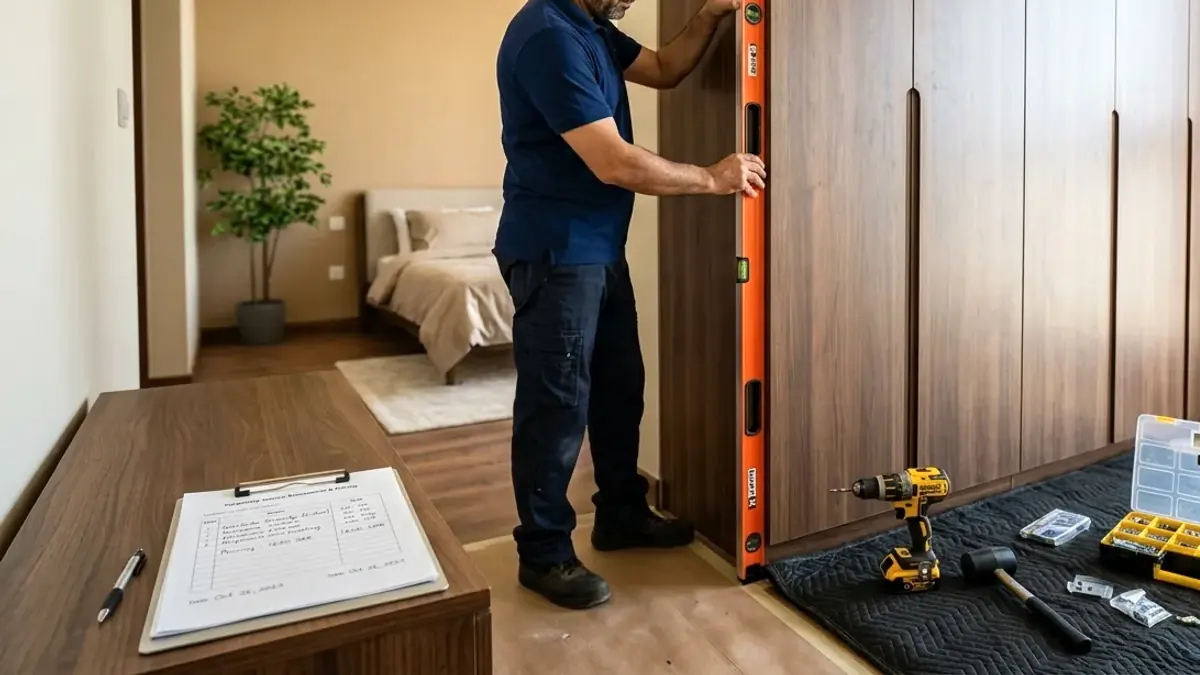
Bedrooms swing the cost most because they mix knock-down and fixed pieces. Photograph the bed from the side and, if possible, from below to show how it is fixed. Shoot the wardrobe closed and then open. If it is a multi-panel unit, say so, because taking it apart needs time and tools.
Photograph the dresser with its mirror, the bedside units and the mattress, adding the size if you know it. If the whole room is solid wood, read about moving wooden bedrooms in Jeddah. For modular wardrobes, see IKEA PAX wardrobe moving.
Photos ready? Send them on WhatsApp 0566300558 with the district and floor.
Majlis and lounge: every seat counts
A large majlis takes visible space in the truck, and the method depends on its type: floor-level Arabic seating, assembled sofas or sectional pieces. Photograph the full row from two angles, then each piece alone. Shoot glass or marble tables separately, since they need different wrapping.
Place a known-size object beside big pieces, such as a door or a standing person, to help judge dimensions. For the cost side of this room, read majlis moving cost in Jeddah.
Do not forget curtains, chandeliers and large rugs. They look small in memory and large when loaded.
The kitchen: photos reveal a lot
Kitchens produce surprises because cabinets may be fixed to the wall or freestanding. Photograph the upper and lower units, built-in appliances and the opening the pieces must pass through. If the kitchen itself is moving, photograph the water, power and gas points, because disconnecting them needs specialists.
For more, read kitchen moving and installation in Jeddah and moving wooden kitchens. Photograph crockery and pantry shelves in place to estimate boxes, and make a plan for perishable food rather than moving it unplanned.
Appliances: the label before the look
Photograph each large appliance from the front and side, then the model label if you can reach it. The label gives dimensions and weight better than a guess. This matters for fridges, washers, split air conditioners and large screens. Note that removing and refitting air conditioners is usually a separate service, so say whether you want it included.
For a double-door fridge, photograph the gap between the fridge and the wall and the width of the door it will pass through. For sensitive equipment such as home theatre systems, see relocating home theatres and OLED screens.
Corridors, doors and lift: the photos nobody takes
Most customers shoot the furniture and ignore the route, yet the route decides crew size and method. Photograph the flat door from outside, the corridor, the inside of the lift with the door open, the stairwell from below if there is no lift, and any tight turn or internal staircase in a villa.
Put a tape measure across the door and lift and photograph it; a visible width number saves three messages. State the floor and the flat number. For upper floors and narrow stairs, read moving from high floors with narrow stairs.
Building entrance and parking: what the driver needs
Photography extends outside. Capture the building entrance, parking, street width, the compound gate, and the clearance of covered parking if it matters. In Jeddah, tower and compound parking varies widely, and some require advance permission or a booked service-lift slot.
These images help the company choose the right vehicle and judge the carrying distance. For the vehicle choice itself, read choosing the right Dyna truck size.
Want a written quote after the photos? Ask for it now.
Children's rooms, the study and spare rooms
Small rooms are the ones that vanish from the count and balloon on the day. A child's room holds one or two beds, a desk, toy storage, mattresses and an endless supply of boxes. Photograph a bunk bed from the side to show how it comes apart, the desk, chair and shelves, and the floor to show the volume of toys.
For a home study, record the number of screens, devices, chairs and files, and photograph the bookcase while full because books weigh more than they look. A spare or guest room is photographed like any other so no unpriced pieces appear later.
Name each room in the caption or file name, for example child room 1, so the mover knows where each shot belongs.
Valuable and fragile items
Some pieces need their own image and a line of text: large mirrors, paintings, chandeliers, glass, ornaments and audio-visual gear. Photograph each clearly and add approximate size. The crew can then prepare suitable protection, whether a wooden frame, panels or extra blankets.
Do not send images that show where very valuable items are kept, such as jewellery or documents; these travel with you. Simply state that they exist and that you will carry them yourself. For specialised wrapping, see furniture packing in Jeddah.
Shooting by housing type: flat, tower, villa or compound
What to emphasise depends on where you live. In towers, show the service lift, the service entrance, the gate and visitor parking. In older apartment buildings, show the stairwell from below, tread width and any turn. In villas, show the internal staircase, courtyard, gate and upstairs rooms. In compounds, show the gate and any rules sign, because some require appointments and permits.
- Tower: lift, booking, clearance.
- Apartment block: stairs, width, floor.
- Villa: internal stairs, courtyard, upper rooms.
- Compound: gate, permit, parking.
A short video that complements the photos
A video of one to two minutes, walking from the entrance through each room, gives the mover a sense of sequence and distance. Speak clearly and name each room. Say what moves and what stays.
Do not let the video replace stills, because photos can be enlarged and inspected. Avoid enormous files; the quickest message is read first.
What to write with the photos
Photos without text leave the mover guessing. Add a short, ordered message covering:
- Current and new district and housing type.
- Floor and whether there is a lift.
- What moves and what will be left or sold.
- Heavy, valuable or fragile items.
- Whether you need dismantling, assembly and packing.
- Preferred date and how flexible it is.
Add any restriction, such as a ban on large vehicles or limited lift hours. That message plus the photos is what a company needs to write a detailed quote.
Common mistakes when photographing for a quote
- One photo for a whole room: it hides whatever stands behind doors and furniture.
- Furniture without the route: you meet entry limits only later.
- Poor light: it hides damage and scale.
- Forgetting stored items: annex, balcony and roof store.
- Cropped frames: cutting corners hides pieces.
- Filters: they change colours and apparent size.
- Scattered sending: images arrive unordered, room by room.
Keep the photos in one album and send a copy to the company.
A note on privacy
Photos from inside a home carry personal information. Before sending, keep documents, family pictures and bank papers out of frame, and close doors to private rooms that are not part of the move. Send the images only to the company's official number you trust, not to open groups.
If you would rather not photograph a particular room, replace it with a written description and measurements. A serious company will accept that or ask for an on-site visit instead. To check a company before sharing details, read how to verify a moving company before hiring.
When to shoot and when to update
The best moment is before you agree a price, and after you decide what moves and what is sold or left. If you shoot while still deciding, you will have to re-estimate. Choose a time of day with good natural light and do not wait until the last day.
Update the photos in three cases: you bought new furniture before the date, you disposed of large pieces, or the new address turns out to have a different lift situation. Early updates cost less than changes on loading day, because the company can adjust crew or trucks calmly. If your move falls in summer, send photos early so a milder slot can be reserved.
Reading the quote once you have sent photos
When the quote arrives, compare it with what you sent. Does it list the large pieces? Does it say who dismantles and assembles? Does it state the number of trucks and crew? Does it say what happens if extra items appear? A quote that never refers to anything in your photos may rest on a generic estimate.
Ask for what is included and excluded in writing, and for confirmation that the estimate is based on your images. Read how to negotiate and verify moving quotes and moving contract clauses in Saudi Arabia to know what should be written.
Your photo set also serves you after the move
Today's photos become tomorrow's reference. If scratches or shortages appear, they prove the condition before loading. Keep them in one dated album and add pictures taken on loading day. See inspecting furniture on arrival.
If you keep a written inventory, tie each entry to a photo number so matching at delivery is simple.
Quick photo checklist
- Lights on, curtains open.
- Two wide shots per room.
- A photo of each large piece, with wardrobes open.
- Appliance labels and sizes.
- Door, corridor, lift and stairs with a tape measure.
- Entrance, parking and street width.
- Annex, store and balcony.
- An optional short video and a message summarising the details.
Frequently asked questions
Twenty to thirty usually do it: two wide shots per room, close-ups of large pieces, and the entrance, corridors and lift.
A video helps with room order and distances but does not replace stills, which can be enlarged and inspected. Using both is best.
They decide whether large pieces pass and whether dismantling or special methods are needed, which directly affects crew and time.
Yes, but label them as staying or being sold, so they are not priced or moved by mistake.
An initial quote can be based on photos and your details, and a company may ask for a site visit on larger moves. The written quote is the reference.
Keep documents and personal pictures out of frame, close private rooms and send images only to the company's official number.
Tell the company and send updated images. The quote was based on what was seen, so additions change the estimate.
Yes. They record each item's condition before loading and help with matching or any note after delivery.
Related pages
- Choosing Dyna capacityHow to pick the truck size
- Inspecting furniture on arrivalCheck pieces after delivery
- Colour-coding boxes by roomLabel boxes by room
- Negotiating and verifying quotesReading the written quote
- Three-room apartment costPrice factors for flats
- One-month moving checklistEarly preparation steps
Ready to shoot? Send photos, district and floor on WhatsApp and we will reply with a written quote once we know the details.