Stretch Wrap vs Bubble Wrap: When to Use Each for Your Move
Stretch wrap binds, bundles and keeps dust off. Bubble wrap cushions knocks. Neither replaces the other. This guide shows which material suits each item in your home, how to layer them, and what changes in Jeddah heat and humidity.
Written contract · photo assessment · general guidance
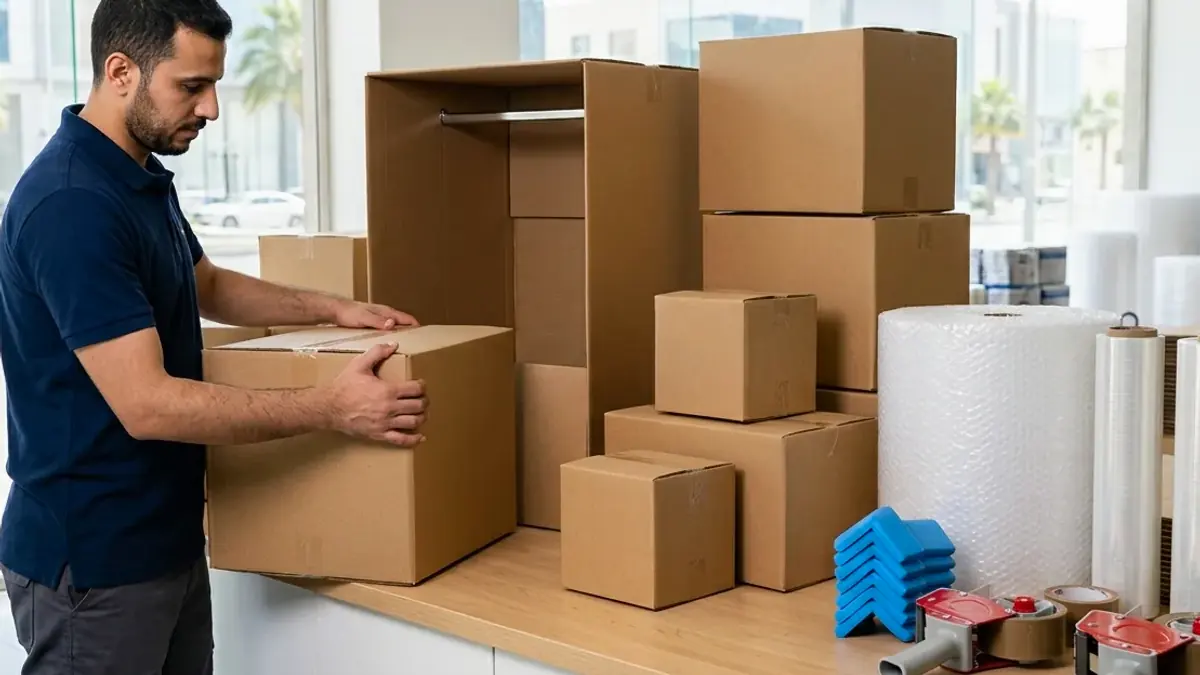
Two materials, two different jobs
Ask a few people what they use to protect furniture and you will hear "wrap" for everything. In practice there are two very different products on a moving day in Jeddah. Stretch wrap is a thin, clingy plastic film that holds things together and keeps dust off. Bubble wrap is a cushioning sheet with trapped air pockets that softens knocks. One binds, the other buffers.
Problems start when a household uses one product for the other product's job. A glass tabletop wrapped only in stretch film looks sealed and professional, yet a single corner knock can still crack it. A wardrobe wrapped only in bubble sheet may arrive with its doors swung open and hinges strained because nothing held them shut.
Before choosing, put two questions to every item. First, could it crack, bend or dent if a hard edge meets it? Second, does it have doors, drawers or loose parts that could open or separate? The first answer points to cushioning and rigid support. The second points to binding. Most items need a bit of both, in different proportions, and this guide shows how to decide without guessing.
We deliberately mention no prices here, because the cost of materials depends on the volume and the type of items once someone has seen the rooms.
What stretch wrap actually does
Stretch wrap clings to itself, so it needs no tape on the furniture. That gives it three practical roles:
- Holding closed: doors, drawers and lids stay shut while the piece is tilted on a staircase or slid across a floor.
- Keeping clean: sofas, mattresses and upholstered chairs are shielded from dust and smudges during loading and the open-air wait before a lift becomes free.
- Bundling: chair legs, shelves, curtain rods and bed slats are gathered into one tidy package so nothing is left behind in an empty room.
What it cannot do is absorb impact. Think of it as a skin rather than a shock absorber. It resists light scuffs and dust, but a hard collision passes straight through. That is why it is a poor sole protector for glass, stone, mirrors or electronics.
Film thickness matters too. Thin film is fine for bundling and light jobs, while thicker film suits heavy mattresses and bed frames. Ask how many turns will go around each piece. One slack turn does little; several firm, overlapping turns hold properly. Firm does not mean extreme: over-tightening can press into thin wooden edges and slim legs.
What bubble wrap actually does
Bubble wrap is two plastic layers sealed around pockets of air. When something presses against it, the pockets compress and spread the force over a longer moment, which reduces the shock reaching the object. Small bubbles are kinder to delicate or finely finished items, while large bubbles suit heavier or bulkier pieces.
The usual practice is to place the bubbles toward the object, with the smooth face outward. It then needs something to stay in place, either tape or a turn of stretch film over the top, because unlike stretch wrap it does not cling to itself.
Bubble wrap has limits too. It supplies cushioning, not stiffness. A tall mirror wrapped in bubble sheet alone can still flex when other items lean on it in the truck. Fragile flat items therefore get a rigid layer, such as corrugated board, before the bubble sheet is secured on the outside.
When you read a written packing description from a mover, check that bubble sheet appears next to the fragile categories, such as glass, ceramics, frames and screens. A line that just says "full wrapping" is too vague to tell you what will protect your mirror.
Want the wrapping level set per room? Send photos of your home on WhatsApp 0566300558.
Side-by-side comparison
| Question | Stretch wrap | Bubble wrap |
|---|---|---|
| Main purpose | Hold, bundle, keep dust off | Cushion against knocks |
| Protects against breakage | Very little | Good, when supported by a rigid layer |
| Protects against light scuffs | Good on tough surfaces | Good |
| Sticks to itself | Yes | No, needs tape or a film overlay |
| Best for | Wardrobes, mattresses, chairs, bundles | Mirrors, glass, decor, electronics |
| Unwrapping at the new home | Quick | Slower, needs care |
The table does not name a winner. It tells you when each one belongs. For one item the answer might be "both", and the next sections explain how the layers fit together.
Items that suit stretch wrap
Choose stretch wrap when the aim is to bind or shield rather than cushion:
- Wardrobes, dressers and chests of drawers, so doors and drawers stay shut.
- Mattresses, sofas and upholstered seating, to keep dust and marks away.
- Dismantled table legs, chair parts and shelf boards, which are bundled by size.
- Rolled rugs, cushions and bedding, compressed into compact bundles.
In high floors and narrow stairwells, bundle sizes matter. An oversized bundle blocks the carrier's view of their feet and rubs the walls. Smaller, lighter bundles pass corners more easily. For more on this, see moving in high floors and narrow stairs.
One more tip: mark every bundle. Clear film hides the contents, and a bundle of anonymous bars can sit in a corner for days after a move. A strip of tape with a room name solves the problem in seconds.
Items that need bubble wrap
When the first thought is "this could break", reach for bubble wrap:
- Mirrors, picture frames and glass cabinet panels.
- Decorative objects, vases, trays and small ornaments, wrapped one by one before they go into boxes.
- Screens and electronics, ideally in their original packaging; read how to pack OLED and smart TVs.
- Corners and edges of polished furniture that will travel close to other pieces.
- Chandelier parts, covered in crystal chandelier moving.
For a full glassware or mirror job, wrapping is only one step; there is also box layout, dividers and weight distribution. Our guide to packing glass cabinets, mirrors and crystal goes through them.
A short rule of thumb works well: if the worry is breakage, use bubble wrap; if the worry is doors opening or dust settling, use stretch wrap.
Layering both: the order that works
Many pieces benefit from a combination. From the inside out, a sensible layering looks like this:
- Soft contact layer: clean paper or a thin cloth on polished or painted surfaces, so plastic never touches them directly.
- Cushion layer: bubble wrap around corners, edges and fragile sections.
- Rigid layer: corrugated sheets on large faces, where flexing is a risk.
- Securing layer: stretch film around everything, firm enough to hold but not crushing.
A tall mirror, for instance, gets a paper sheet, bubble wrap on the face and edges, cardboard on both sides, and a final wrap of stretch film. Each material does one job, and none of them is asked to do another's.
This does not mean all furniture needs four layers. A plain wooden chair may need only stretch film and a blanket in the truck. Instead of applying one standard to the whole house, ask the mover which level is planned for each category and write it into the quote.
Jeddah heat and humidity: what changes
Jeddah is hot and humid for much of the year, and that affects wrapping choices in practical ways:
- Polished and lacquered wood: plastic film left in direct contact for a long time in strong heat can stick to a finish or leave a mark. Add a soft layer underneath and unwrap soon after arrival.
- Leather and fabric: sealed plastic traps moisture. If a piece will wait for days, use a breathable cover instead of a tight film.
- Truck in the sun: the cargo area heats up. Try to keep the gap between loading and unloading short and avoid parking wrapped pieces in direct sun for long.
- Electronics: let them reach room temperature before powering them on.
Our page on protecting furniture from Jeddah summer heat and humidity covers more. After arrival, remove plastic from wood and leather first and let the pieces breathe in an air-conditioned room.
Have glass or mirrors to move? Ask for a written quote stating how each category is wrapped.
Jeddah scenarios: towers, compounds, villas, old stairwells
Apartment in a tower: lift time is often limited or booked. Have items wrapped and staged by the door before the crew arrives, so the lift slot is spent carrying and not wrapping. Compact wraps fit narrow lift doors better.
Gated compound: many compounds ask for notice before a truck enters and set where it may stop. Confirm the rules with the management, then plan the wrapping so loading is quick and the entrance is not blocked for long.
Multi-floor villa: interior distances are long and the volume is higher, so labelling is critical. Use stretch film to unite each room's loose parts, add a label, and keep bubble wrap for fragile pieces only. That prevents the truck from becoming a block of plastic nobody can sort.
Older building with a narrow stairwell: contact with walls and door frames is the main risk. Add extra layers at corners and consider wall protection; see protecting walls, door frames and elevators.
In short, the right wrap depends on the route as much as on the object.
Common wrapping mistakes
- Stretch film alone on glass: it feels sealed, but it does not stop breakage.
- Over-tight film on thin wood: it can mark edges and strain weak joints.
- Bubbles facing out on a fine gloss surface: may leave a dotted impression.
- Ignoring corners: most scuffs start on corners and edges, which deserve extra layers.
- Wrapping damp items: trapped moisture leads to odours and mould in humid weather.
- No labels: clear plastic hides what is inside.
- Cutting film with a sharp blade on the piece: scratches the surface; cut from a safe spot.
Another is believing more layers always mean more safety. Extra layers add volume in the truck and slow loading. What matters is putting the right layers in the right places.
How to brief your movers on wrapping
Instead of saying "wrap everything", send room photos and describe categories:
- Glass and mirrors: bubble wrap, rigid board and support.
- Wardrobes and beds: stretch film with extra corner protection.
- Appliances and screens: bubble wrap and suitable boxes.
- Bedding and soft items: bags or film, depending on the amount.
Then ask that the written quote states the wrapping level for each category and whether materials are included or charged separately. We give no figures here, because pricing follows quantity, materials and floor access. For a general comparison of materials and cost drivers see packaging materials cost comparison, and to read about the full service see furniture packing in Jeddah.
Ask about packing materials in writing before you book, so everything is clear.
After arrival: unwrapping and checking
Open wrapped items in the room where they will stay, not in the hallway, so packaging does not pile up in the crew's way. Start with moisture-sensitive pieces such as polished wood and leather, then continue with the rest.
- Cut stretch film along a side, away from the surface.
- Peel bubble wrap slowly and look for cracks or frame marks.
- Compare each item with its photos taken before the move and note anything unusual on the spot.
- Bag the packaging and agree with the crew whether they take it away.
- Leave wooden and leather pieces uncovered in an air-conditioned room before adding any new covers.
Do not forget the unseen sides, such as the back of a wardrobe or under a table. For a fuller routine read furniture inspection checklist on arrival, and for the first evening in the new place see the first-night survival box.
Quick checklist before loading day
- Sort items into fragile, heavy, dismantled and soft goods.
- Mark polished or leather pieces that need a soft layer first.
- Make sure appliances are dry and have cooled down.
- Keep tape and markers ready for room labels.
- Clear stairwells, lift access and truck parking.
- Agree who removes packaging after unloading and where it goes.
- Photograph key pieces before and after wrapping.
- For a Friday or peak-day move, wrap fragile items the evening before, since rushing at the last minute is the main cause of poor wrapping.
To organise the boxes themselves, read colour coding boxes for room placement.
Questions about stretch wrap and bubble wrap
Often yes for dust, light scuffs and keeping doors shut, as long as a soft layer separates it from polished surfaces in hot weather. Corners usually need extra protection.
It is better not to rely on it alone. A mirror needs rigidity as well as cushioning, so bubble wrap is paired with cardboard or boards and then secured.
Usually the bubbles face the object. On fine glossy surfaces, a sheet of clean paper goes first so no dotted pattern appears.
It can on some finished surfaces if it stays in contact for a long time in strong heat. A soft layer underneath and early unwrapping reduce the risk.
They benefit from a cover against dust and stains. Wrap firmly but without extreme tension, and carry the mattress in the orientation the route allows.
It varies. Ask for the quote to state whether materials are included or charged separately, and which level of protection applies to each category.
Gather it in large bags and put it out with household waste, or agree beforehand that the crew takes it. Some cardboard and plastic can be reused.
You can handle simple things like books, clothes and bedding. Large or fragile pieces are better wrapped by the crew so the method is consistent and responsibilities are clear.
Related pages
- Furniture packing in JeddahThe full packing service
- Packaging materials cost comparisonWhat drives material costs
- Bubble wrap vs corrugated cardboardWhich protects more
- Choosing the right moving box sizesRight size for each content
- Protecting furniture from Jeddah heatSummer tips
- Packing glass, mirrors and crystalFor fragile items
Planning a move in Jeddah? Send your room photos on WhatsApp and we will set out the wrapping for each category in writing.