Bed bolts and wardrobe screws: a simple system that stops losses
To keep furniture screws safe when moving, photograph each piece before you take it apart. Put the screws of each piece alone in a zip bag marked with its number. Tape the bag to the piece, or keep all bags in one parts box that travels with you, not in the truck. This page covers the types of small parts, how to store each one, and what happens if a screw goes missing.
One bag per piece · Photos first · Parts box with you
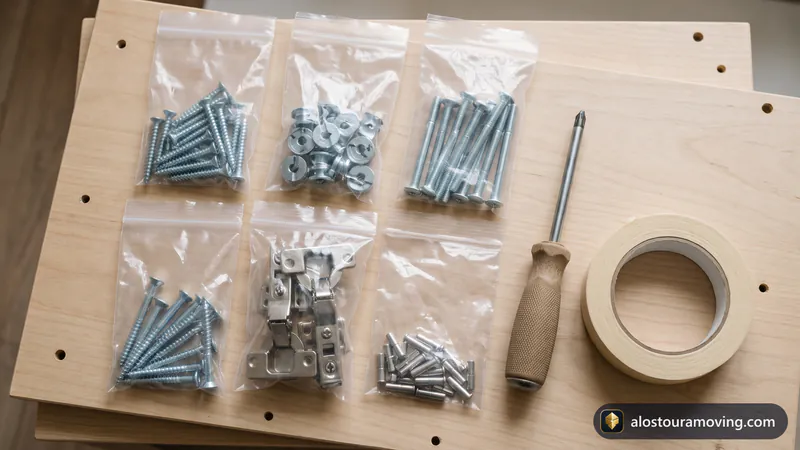
Why screws go missing in almost every move
A screw does not break or scratch. It just disappears. It ends up in a pocket, in a kitchen box, or on the floor of the old flat. Then at the new home the bed cannot go back together.
The cause is rarely carelessness. It is the lack of a system. When five pieces come apart in one room, similar screws mix fast. That is why our furniture dismantling and assembly in Jeddah starts with one step: deciding where each piece's parts will go.
Success is easy to see. On assembly day the carpenter opens one bag per piece. Everything needed is inside, and nothing else.
Know the small parts before you start
Not every part is a screw. Modern furniture, flat-pack in particular, uses several kinds of fittings. Each one needs a slightly different approach.
| Part | Where you find it | How to keep it |
|---|---|---|
| Wood and metal screws | Beds, wardrobes, tables | In that piece's own bag, never mixed |
| Cam locks | Flat-pack wardrobes and desks | In the same bag as their bolts, they work as a pair |
| Wooden dowels | Between particle board panels | Leave fixed ones in place, bag the loose ones |
| Long bed bolts | Bed corners and base | A separate bag marked bed corners |
| Hinges and door arms | Wardrobe and cabinet doors | Usually stay on the door, number any you remove |
| Shelf pins and brackets | Bookcases and wardrobes | A small bag with the count written on it |
Cam locks look alike but sizes differ between wardrobes. Mix them up and the panel will be loose after assembly.
Photograph the piece first
A photo is the cheapest assembly manual. Take a full shot of the piece from the front and sides. Then take close shots of each joint. If you still have the paper instructions, put them in the piece's bag.
- One wide photo of the piece in its place.
- One photo of each joint before it comes apart.
- One photo of the panels after numbering.
- One photo of the bag contents before you seal it.
These photos also record the condition of your furniture. See documenting furniture condition before moving.
The numbered bag system, step by step
Our system is simple. You can use it yourself if you take some pieces apart before we arrive. You need clear zip bags, a marker and paper masking tape.
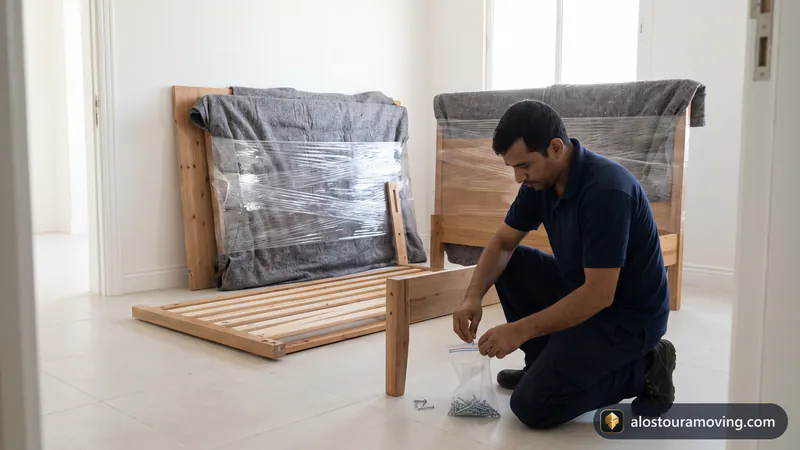
- Give each piece a number and a room, like master bedroom, wardrobe 2.
- Write the same number on every panel using masking tape, not pen on wood.
- Put all screws and small parts in one bag and write the number and count.
- Tape the bag inside the largest panel, away from glossy faces.
- For big pieces, put the bag in the parts box and note it on the inventory.
Do not stick tape straight on glossy or white surfaces. In the heat it can leave a mark. Use the hidden inner side or the wrapping layer.
Have beds and wardrobes that need taking apart? Send photos on WhatsApp and we will write a quote that covers the carpenter, packing and the move.
The parts box rides in the cab, not the back
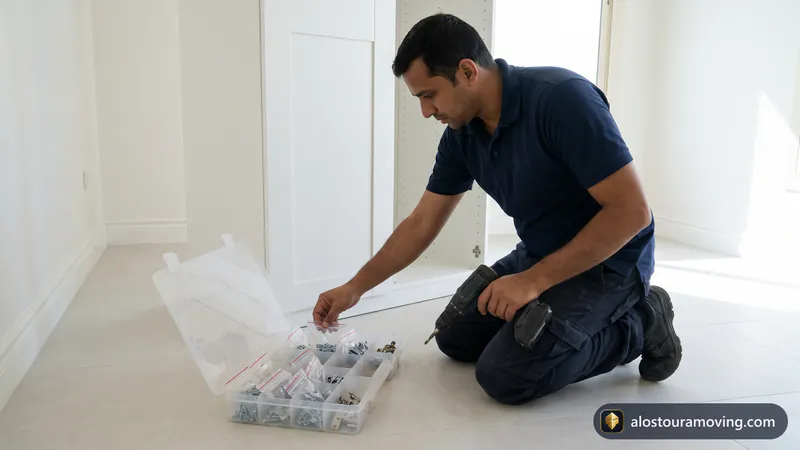
When there are many bags, put them all in one plastic box with a lid. It is the smallest box in the move and the most important one.
So it does not go in the back with the cartons. It travels with our supervisor in the truck cab or with you in your car. At the new home it goes straight to the carpenter.
- Put in: screw bags, wardrobe keys, remotes, TV and mirror brackets.
- Add a few first-night tools: a small screwdriver, scissors and tape.
- Keep out: gold, cash and key papers. Those stay with you at all times.
It works like a first-night box. See the first-night essentials box to plan both together.
A real example: one full bedroom
Take a normal bedroom in a Jeddah flat: a king bed, a six-door wardrobe, a dresser with a mirror and two bedside units. This one room can hold dozens of screws, cam locks and shelf pins.
- The carpenter photographs the wardrobe, bed and dresser first.
- Wardrobe is number 1, bed is 2, dresser is 3. The bedside units move whole.
- Wardrobe door hinges go in bag 1, and each door gets its number on tape.
- The long bed bolts go in their own bag, marked bed 2, corners.
- The mirror comes off the dresser and is wrapped alone. Its screws go in bag 3.
At the new home it runs in reverse. The bed goes up first, because you need it on the first night. One bag per piece means no guessing.
Wall-mounted items: TV, mirrors and curtains
Hanging items have two parts: the item and what holds it to the wall. Decide before you start if the TV bracket and curtain rails stay or move with you.
If they move, bag the bracket screws and tape the bag to the bracket. Plastic wall plugs are rarely reused. Buy new ones that suit the new wall.
Mounting a TV on a new wall means checking the wall type and hidden cables. We agree this in advance. For curtains and light fittings see curtain and chandelier fitting.
Jeddah humidity and old screws
In homes near the sea, some screws rust over the years. This is common in metal beds and in bases that sit near bathrooms. A rusty screw can snap or lose its grip.
- If a screw resists, do not force it. The carpenter picks the right tool.
- A screw with a damaged head or thread is replaced, not reused.
- Keep screw bags dry and away from kitchen and bathroom items.
- Seal bags well. Damp inside a closed box in the heat speeds up rust.
Heat and damp affect the furniture itself even more. Read moving furniture in Jeddah heat and humidity.
A screw is missing on assembly day
Even with a good system it can happen, often with furniture someone took apart before us. The worst fix is forcing in a screw that does not fit.
| Situation | What the carpenter usually does | What you do |
|---|---|---|
| Common screw lost | Replaces it with a matching size if available | Usually nothing |
| Brand-specific cam lock lost | Fixes the piece safely for now if possible | Order the part from the shop |
| Screw hole stripped | Suggests a fix that suits the wood | Approve the fix first |
| Wardrobe key lost | Does not break the lock | Check the parts box first |
If you know a piece is already missing screws, tell us when you ask for a quote. The carpenter can then come prepared.
Pieces that do not need dismantling
The best way not to lose screws is not to remove them. Many pieces move whole if they fit the door and lift. Each time flat-pack is taken apart, the board gets weaker.
- Small tables, chairs and bedside units.
- Small wardrobes that pass the door upright or tilted.
- Flat-pack that has been rebuilt many times already.
- Glued or nailed furniture.
See when wooden furniture needs a carpenter, and for flat-pack read dismantling IKEA furniture without damage.
Your part and our part
On the day, our carpenter takes pieces apart, bags and numbers the parts. The supervisor keeps the parts box until the new home and sends you progress photos on WhatsApp.
| Task | You | Our crew |
|---|---|---|
| Empty wardrobes and drawers | Yes | We help if needed |
| Decide what moves and what stays | Yes | We suggest |
| Dismantle, bag and number | No | Carpenter |
| Carry the parts box | If you prefer | Supervisor, in the cab |
| Assemble in final spots | You choose the spots | Carpenter |
Empty drawers before the day to save time. To keep doors and drawers shut in transit, see securing wardrobe drawers and hinges.
Quick check before the last bag is sealed
- Every dismantled piece has its number on its panels.
- Every bag shows the piece number and the count.
- Photos are saved in one album.
- Wardrobe keys are in the parts box.
- The parts box is with the supervisor or you, not in the back.
- You have decided if wall brackets stay or move.
With this list done, assembly is faster than dismantling. When we arrive, check each piece with the arrival inspection checklist before the crew leaves.
Frequently asked questions
No. One bag for the whole home wastes hours on assembly day, because similar screws come in different sizes. Give each piece its own bag, marked with its number and how many parts are inside.
Tape them inside the largest panel of the piece, or collect them in one lidded parts box. That box travels with our supervisor in the cab or with you in your car, never among the cartons in the back.
For a common screw size, the carpenter usually replaces it with a matching one. Some brand-specific fittings must be ordered from the shop. The key rule is never to force in a screw that does not fit.
Yes. On the day, the carpenter takes pieces apart, bags each piece's parts and numbers its panels. The supervisor keeps the parts box until the new home. Your job is to empty wardrobes and drawers first.
Avoid writing on wood. Write on paper masking tape and stick it on a hidden inner face or on the wrapping. Some tapes leave marks on glossy surfaces in the heat.
No. Small pieces and wardrobes that fit through the door and lift can move whole. Flat-pack that has been rebuilt many times is often safer moved whole, because each new dismantling weakens the screw holes.
Not always, since some furniture comes with spares. Still, ask the carpenter to recheck the piece that bag came from before leaving, so every joint is tight.
Related pages
- Precision Furniture Disassembly & Reassembly Services in Jeddah
- Documenting furniture condition
- The First Night Survival Box: Vital Essentials You Must Transport Personally
- Careful Chandelier and Curtain Installation Services in Jeddah
- Moving in heat and humidity
- When wooden furniture needs a carpenter
- Tips for Taking Apart and Packing Flat-Pack IKEA Furniture Without Damaging the Particleboard
- Securing wardrobe drawers and hinges
Do not want to worry about screws and parts? Message us on 0566300558. Our carpenter dismantles, numbers and rebuilds, with price and liability terms in a contract before loading.