Moving Furniture in Jeddah When the Truck Cannot Reach Your Door: A Guide to Narrow Lanes and Long Carries
Narrow lane, restricted compound gate or a street where stopping is banned? This guide shows how to measure the carry, choose between a hand-over chain, a two-stage move and a crane lift, and what to put in writing before moving day.
General honest guidance, not a commitment; the final method is set after we see photos of your site.
Short answer: what to do when the truck parks far from your door
If the moving truck cannot get to your entrance, you do not have an impossible move. You have a distance problem.
Measure the walk from the spot where the truck can legally and safely stop to your front door, note every bend, step and gate on the way, then pick one of three methods: an organised hand-carry chain, a two-stage move using a smaller vehicle to shuttle items to the truck, or lifting the big pieces out by crane from a different side.
This guide is about that situation: old-town lanes, buildings packed shoulder to shoulder, compounds with restricted gates, and streets where stopping is not allowed. It is different from our guide on narrow doorways and spiral stairs, which deals with what happens inside the building. Here we ask: how many metres will the furniture travel on foot, and how do we plan around it?
If you are looking for movers in Jeddah who will tell you the plan in writing before moving day, send photos of the lane and entrance to Al Ostoura Moving on WhatsApp at 0566300558. We do not quote a figure before seeing photos.
Four common versions of "the truck cannot reach us"
The fix depends on why the truck stops short. These are the four patterns we see most often for moves inside Jeddah:
| Situation | Usual cause | What it does to the plan |
|---|---|---|
| Lane narrower than the truck | Close-set buildings, parked cars on both sides | Truck stops on the first wide street; the gap is carried or shuttled |
| Entrance deep inside a compound | Guarded gate, permit rules, restricted internal roads | Truck parks at the gate or a set bay; paperwork may be needed in advance |
| Busy commercial street | No-stopping zones or heavy traffic at certain hours | A short loading window, then the truck leaves |
| Older house with a low or crooked entrance | Narrow doors, thresholds, sharp corners, uneven stairs | Dismantle first and plan the route step by step |
Two can combine. An old house in a lane the truck cannot enter means long-distance carrying and dismantling together. That is why we ask for photos of the lane itself, not only the rooms.
Three measurements to take before you call any mover
A serious furniture moving company in Jeddah will ask for these, so having them ready saves a day of back-and-forth:
- Carry distance. From the nearest point the truck can stand to your front door. Use the walking mode on a map app and drag between the two points.
- The tightest point on the route. The narrowest width and the lowest height between your door and the truck: a gate, a passage between two walls, the building entrance.
- Moving obstacles. Cars usually parked in the lane, bins, chains across the road, nearby digging or roadworks.
You do not need special tools. A tape measure and a few photos with the tape visible are enough. If the lane narrows and widens along its length, photograph the narrowest spot and tell us where it sits along the route.
Carry distance is the first thing that changes time and crew
Every extra metre between truck and door is repeated for every piece of furniture and every carton. A typical home has a great many of both, so turning a short walk into a long one multiplies the trips. In some homes this matters more than the number of bedrooms.
It is not only about speed. Longer carries mean more contact with walls and more tired carriers, so the load has to be shared along the route rather than one person walking the whole distance with a heavy piece.
- A short distance usually allows direct carrying with extra hands at the doors.
- A medium distance needs a hand-over chain and trolleys for cartons and small items.
- A long distance points to a two-stage move or loading in batches.
Decision table: which method fits which distance
Use this as a thinking aid, not a rule and not a quote. We give no metre or riyal figures here because your lane and your load decide it:
| Distance | Likely method | When to avoid it |
|---|---|---|
| Short: truck near the entrance | Direct carry with roles assigned | Very heavy pieces on a slope |
| Medium: a few minutes on foot with a load | Hand-over chain plus trolleys for cartons | Wet, uneven or slippery ground |
| Long: truck on a distant street | Two-stage move, or loading in batches | No safe collection point halfway |
| Closed: no truck access at all | Crane lift from another side, or a special arrangement | No space on that side, or exposed power lines |
Whichever method is chosen, it should appear in the written agreement so nothing changes on the morning of the move.
Send photos of the lane and its tightest point on WhatsApp 0566300558 and we will suggest the right method.
Method one: stop at the nearest safe point and carry in an organised chain
When the distance is manageable, hand-carrying is the simplest approach. It works because of organisation, not muscle. Picture a hand-over chain: instead of every worker walking the whole route, each takes a position and passes the load to the next person.
- One worker at the door prepares each item and checks the wrapping.
- One or two in the middle at bends and thresholds, which are the riskiest spots.
- One at the truck who receives, positions and secures.
- A coordinator who can see both ends and decides what goes now and what waits.
Cartons move fast along the chain; large pieces need two or more carriers and a pause at each corner. We plan the two flows separately so that one never blocks the other.
Method two: a two-stage move with a smaller vehicle
If the distance is long, it is often better not to carry by hand at all. Stage one uses a small vehicle that can get through the lane, running from your door to a collection point on the wide street. Stage two loads the big truck from that point.
The drawback is extra loading and unloading, which means more touches on every piece. We only use it when hand-carrying would be harder or riskier. Its benefit is that fewer people walk long distances with heavy loads.
- Fix the collection point beforehand: level ground, out of the way of traffic, and somewhere items can be watched.
- Never leave collected items unattended; someone should stay with them.
- Agree the stages in writing, and who covers any extra trips.
Because it changes trip count and duration, it must be part of the written quote. See our guide to questions to ask a moving company before booking for how to ask.
Method three: lifting from another side with a crane
When the flat is high up and the lane is closed, the best answer may be to lift heavy pieces out of a window or balcony facing the more open side, instead of carrying them down the stairs and along the lane. That needs a site check: is there room for the crane, are power lines clear, does the window fit the item?
Read when a furniture hoist is necessary in Jeddah for the signs, our furniture lifting service for how we work, and furniture hoist cost factors for what drives the price.
Older districts and Al Balad: what is different in practice
Some of Jeddah's older districts have narrow lanes, closely packed buildings and stairs of uneven width, and large trucks may not be able to enter. Many of these buildings have no lift and may have low or narrow entrances. This is not true of every house, but it is common enough to make photo inspection essential.
There are three things to look at: where can the truck stop legally and safely, what is the narrowest point, and what is the stair like inside. You can read about our service in the area on the Al Balad moving page.
Older houses also need extra care around frames, wooden doors and railings, because a long carry increases rubbing. Put protection on corners before starting, as we describe in protecting walls and door frames.
Compounds: the gate, the permit and the bay
In compounds the problem is often rules rather than width: set hours for trucks, a permit requested in advance, a designated bay that may be far from your building. The principle is to ask the management before moving day, not on it.
- Are trucks allowed in, and at what hours?
- Is a permit needed, in the resident's name or the company's?
- Is there a service lift or designated route?
- Are there floors or kerbs that need protecting?
We cover this in more depth in building management permits in Jeddah compounds. If your move is between two districts, our inter-district moving page explains how we plan the route.
The street and the neighbours: cars, parking and timing
Very often the real obstacle is a car parked at the lane entrance. Talk to the neighbours the day before, leave your phone number, and put a note up on the morning. Do not assume the street will be empty on the day.
See parking moving trucks on congested Jeddah streets for options when there is no space near the building.
Order of exit: what leaves the house first
A good sequence keeps the passage clear. Small, sealed cartons go first because they do not block the route. Then medium pieces, and the big heavy items wait until the route is empty and ready. This is similar to stair planning but matters more with a longer distance.
| Stage | What goes out | Note |
|---|---|---|
| First | Sealed cartons and bags | Loaded at the front of the truck or at the collection point |
| Second | Medium pieces: chairs, small tables | Wrapped in moving blankets before leaving |
| Third | Dismantled wardrobes and beds | After the route is confirmed clear |
| Fourth | Heavy items: fridge, washer, safe | Special preparation and enough carriers |
Protecting furniture on a long carry
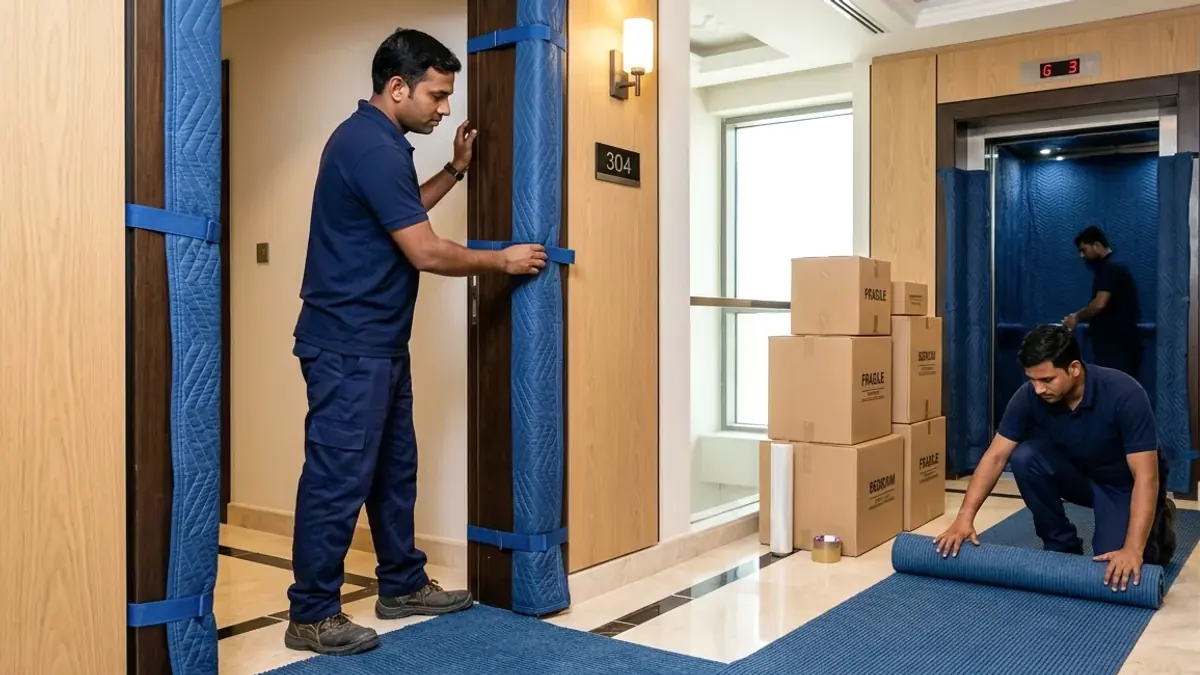
The longer the route, the more chances for a piece to brush a wall or the ground. Protection here is not optional. Large pieces are wrapped in moving blankets and secured with tape that will not stick to the surface; corners get guards; sensitive floors get runners. Our guide on how moving blankets work in a Dyna truck explains the wrapping.
- Do not wrap glossy surfaces tightly in plastic for long periods in the heat.
- Drawers and doors are secured with tape or straps first; see securing drawers and cabinet doors
- Mirrors and glass travel upright with a person who stays with them.
High floor or heavy pieces? Mention them in your message so they go into the plan.
Dismantle first: shrink the load instead of enlarging the crew
The easiest way to lighten a long carry is to make the pieces smaller. A wardrobe broken into panels is lighter and less likely to be bumped; a bed taken apart needs fewer carriers. But dismantling does not suit every item: old, brittle wood may not survive coming apart and going back together. That judgement is made from the photos.
See furniture disassembly and assembly and our guide to dismantling IKEA furniture without damage to see what is taken apart and what travels whole.
Heavy appliances on a long route
A fridge, washing machine or freezer needs to be carried upright, with a trolley or straps and enough people. Over a long distance the risk of tilting and shaking grows. Prepare the appliance as described in preparing refrigerators 48 hours ahead and disconnecting and transporting washing machines.
If you are wondering what moving these appliances costs, we have a separate page: cost factors for moving a fridge, washer and large appliances.
Safety on the route
- Wet or sandy ground changes grip; clean it or lay runners.
- Carriers agree simple calls: stop, lower, turn.
- No piece is carried if it is heavier than the team can control.
- Rest breaks in the heat, and water for the crew.
- Children and pets are kept away from the route all day.
The rule is simple: if the team feels the route is unsafe, they stop and rearrange rather than gamble with the piece or the person.
A simple diagram of the route from door to truck
This sketch shows the sequence of points from your door through the narrow section to a collection point and on to the truck.
If the route stalls at any box because of an obstacle, the mover should already know the fallback.
Worked example one: third-floor flat, no lift, truck on the main road
An illustrative case, not a quote. A flat on the third floor of a building without a lift, in a lane too narrow for the truck, which waits on the main street. This needs two plans working together: managing the stairs inside, and managing the distance outside.
- Photos of the lane, building and stairwell showing width.
- A walking-distance estimate from the map app.
- Beds and wardrobes taken apart and wrapped beforehand.
- Crew spread over three positions: the floor, the lane and the truck.
- A guarded collection point near the truck.
If the stair doors are tight, see narrow doorways and spiral stairs. For how upper floors affect price, read fifth floor without a lift: moving cost factors.
Worked example two: an old house with a low wooden entrance
An older house with a low entrance and a wooden door that will not take rubbing, in a lane only a small vehicle can enter. Here the priority is protecting the house before protecting the furniture: cover the frame, fix guards in place and map the route before the first piece is lifted.
- Measure the real door height once the threshold is taken into account.
- Dismantle what cannot pass whole.
- Keep fragile items out of the long hand-carry and send them in the two-stage run.
- Agree in writing who is responsible for any damage to the old frame and how it is documented.
Worked example three: a villa in a compound with a set permit
A villa in a compound with a gate and entry rules. The distance from the gate to the villa may be large, but the road is wide. The challenge is administrative: getting the permit and a bay for the truck. Often a smaller truck or a scheduled entry window solves it.
Ask management to put the rules in writing and send them to us so they go into the plan. For villas in general see villa moving in Jeddah.
Common mistakes when the truck cannot reach the door
- Guessing the distance by eye. A lane that looks short is long with a wardrobe in your arms.
- Forgetting the neighbours. One parked car can wreck the day.
- Photographing rooms but not the lane. The mover cannot see the real problem.
- Relying on a verbal promise. Without writing, the method and any extras become an argument.
- Unlabelled cartons. Stages get mixed and things go missing.
- Leaving items unwatched on the street. Risk of loss or damage.
- Asking management too late. A ban can surface on the morning.
What to send a mover to get an accurate plan
Good photos save long chats. Send all of this together on WhatsApp:
- The map location and where you think the truck can stop.
- Photos of the lane from both directions, including the narrowest spot with a tape measure.
- Photos of the entrance, stairs and any lift.
- Photos of large and heavy items with approximate sizes.
- Whether the building or compound needs a permit, and during which hours.
- Your preferred date and how flexible it is.
We explain how to photograph your home in photographing furniture for a moving quote and how to build an item list in furniture inventory before loading.
What belongs in the written agreement
- Where the truck stops and how items get from door to truck.
- Whether there is a two-stage move and how many trips are expected.
- Who arranges permits or the parking bay.
- Crew size, approximate duration, and what happens if the plan must change.
- Which pieces are dismantled and which travel wrapped.
- How the condition of items is documented beforehand; see documenting furniture condition before moving.
Al Ostoura Moving works with a written contract and holds commercial register 4030592817. Ask for everything we agree on to be written down before moving day.
Ask for a photo assessment and a written agreement before moving day, by WhatsApp or phone.
Checklist for the day before
- Measured carry distance and the tightest point, with photos.
- Told neighbours and management; permit in hand if needed.
- Agreed where the truck stops and where the collection point is.
- Dismantled and wrapped what we agreed.
- Labelled cartons by room; see colour-coding boxes by room
- Emptied and prepared heavy appliances.
- Water ready for the crew; children and pets away.
- Our coordinator number and WhatsApp 0566300558 saved.
When to ask for a consultation instead of reading further
If your lane barely lets a car through, your house is old and fragile, or your heaviest pieces are on upper floors, do not rely on reading alone. Send photos and ask for a photo-based assessment; the right method starts with a picture, not an article.
To compare firms, read how to choose a licensed moving company in Jeddah. For general services, see the home page for a furniture moving company in Jeddah and our furniture moving service.
Common questions about moving when the truck cannot reach the door
Measure the walk from the nearest spot where the truck can stop to your door and photograph the tightest point on the route. Send both to the mover. Then the method is chosen: an organised hand-carry, a two-stage move with a smaller vehicle, or a crane lift from another side.
Yes, because every piece and carton travels the same distance. The duration is estimated once the distance is known, and the agreed method is written into the quote.
Open a map app, choose walking mode, and mark the spot where the truck would stop and your door. It gives an estimate; walk it once if you can and take photos of the route.
It can be, provided items are wrapped, dismantled where suitable, and carriers are positioned along the route. Very fragile or very heavy pieces may need another approach such as a two-stage move or a crane.
Some compounds and buildings require a permit or fixed hours for trucks. Ask management before moving day and send us the conditions in writing so we can build them into the plan.
Sometimes, if there is an open side, safe space, clear power lines and a window that fits the item. We decide after seeing photos of the site.
Talk to the neighbours the day before, leave your number and post a reminder that morning. If it is still blocked, call us before the crew arrives so we can adjust.
No. Carry distance, floor level and the items all change the plan, so we answer your photos with a clear written quote.
Related guides and pages
- Narrow doorways and spiral stairsStairs inside the building
- Parking moving trucks on congested streetsBefore the truck arrives
- Building management permitsWhat management will ask
- When a furniture hoist is neededAn alternative to long carries
- How many workers do you needEstimating the crew
- Moving in Al BaladOlder districts
- Furniture lifting by craneThe service
- Heavy furniture movingHeavy pieces
Send the map location, photos of the lane, entrance and large items to WhatsApp 0566300558. We will agree the method with you and put it in the contract before moving day.