Automatic Washing Machine Moving in Jeddah: Disconnect, Carry, Reinstall
We disconnect your automatic washing machine, secure its door and drum, carry it upright with scratch protection, then position and reconnect it at your new place in Jeddah, planning around towers, limited lifts and humid weather.
Written contract · photo assessment · general guidance
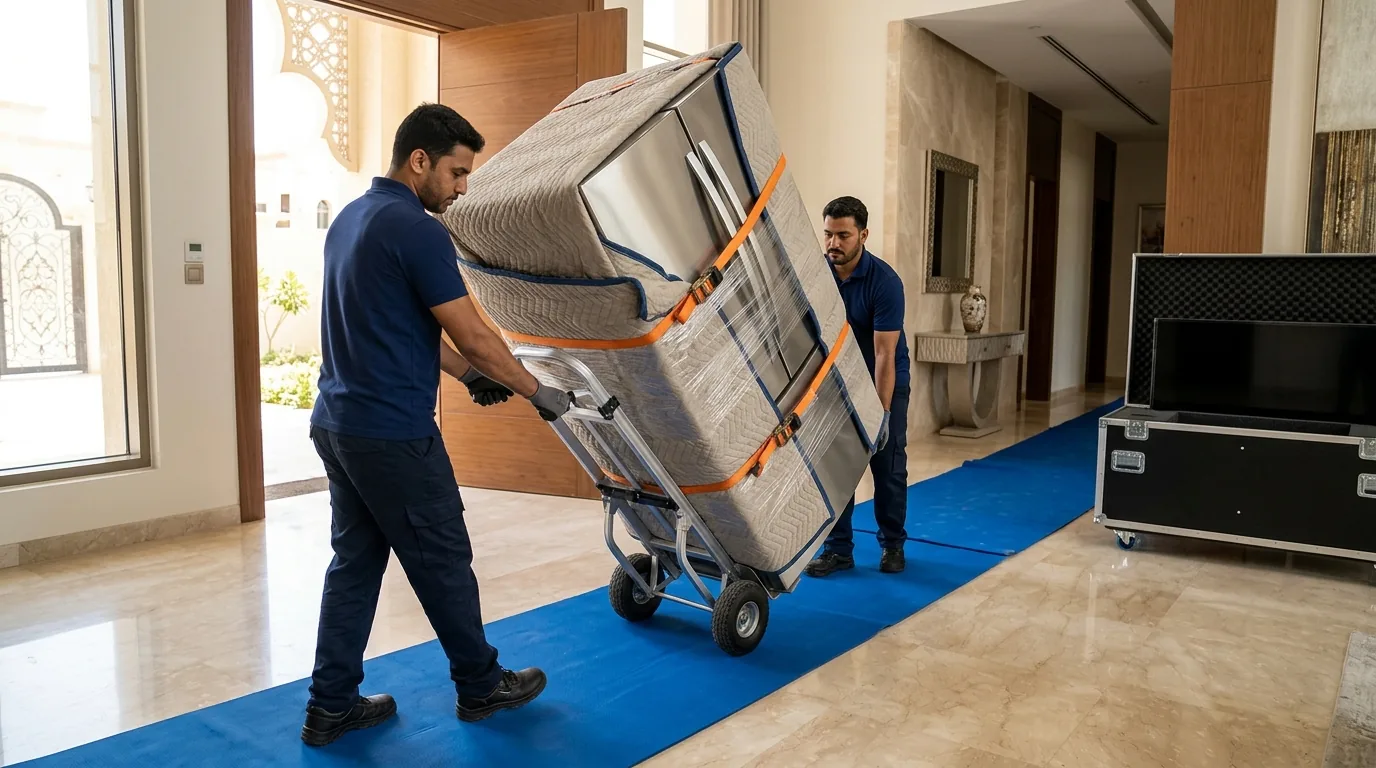
Moving an automatic washing machine in Jeddah
A washing machine looks like a simple heavy box, which is exactly why so many get damaged in transit. Inside is a drum assembly hanging on springs and dampers, a motor and drain pump, a control board and a set of hoses. If the machine is tilted, dropped on its side or left sliding around a truck, the fault may only show a few days after reinstallation, and the owner assumes the appliance was simply old.
This page sets out our washing machine moving service in Jeddah: what the work includes, what we ask you to prepare, how front-loaders and top-loaders differ, and how we handle towers with limited lifts. The step-by-step disconnecting routine has its own page, disconnecting and transporting washing machines; here the focus is on the service itself.
To talk to us directly, message 0566300558 on WhatsApp with a photo of the machine and where it stands now.
What is inside, and why it is not carried like furniture
Behind the metal casing, the drum hangs on springs and shock dampers that soak up spin vibration. A heavy counterweight, made of concrete or metal, sits around the drum. Below are the motor and pump, and above or behind is the electronic control board. All of these parts are built for upright operation and are not designed to take side knocks or being turned over.
That is why a washer is handled differently from a wardrobe. It should not be dragged by one corner, lifted by the door or lid, or left free to rock in the truck. If it tilts, the counterweight can shift, and the result later is heavy shaking or odd noises during the spin cycle.
A machine should also never travel with water in it. Residual water adds unexpected weight and leaks through hoses and the pump. That is the reason for draining and drying beforehand, and for asking you to run a drain cycle the day before if possible.
What the service covers, and what it does not
So that both sides know where the boundaries are:
- Disconnecting water and power: closing the taps, detaching the inlet hose and drain hose, and emptying what remains in them.
- Preparing for transport: securing the door, tidying cables and hoses, and protecting corners.
- Carrying and loading: moving the machine upright with straps or a suitable trolley for the route.
- Unloading and positioning: placing it where you want and checking that it sits level.
- Basic reconnection: connecting hoses to the existing taps and drain so it is ready to use.
It does not cover plumbing or electrical modifications, such as running new pipes, moving a drain outlet or fitting a new circuit breaker. Those need a qualified plumber or electrician, ideally booked before moving day at the new home. If your machine is built into a kitchen unit, also see home appliances moving.
Front-loader or top-loader: is the method the same?
The principles match, but the details differ:
| Point | Front-loader | Top-loader |
|---|---|---|
| Door position | On the front, must be secured | On top, lid must be secured |
| Securing the drum | Often transit bolts at the back are recommended | Some models use special clips or straps |
| Weight and balance | Heavy, weight low down | Often lighter but taller |
| Passing doorways | Wider | Taller |
| Main transit risk | Drum movement, damaged dampers | Lid damage and tipping forward |
Transit bolts are worth a note. They lock the drum to the frame while the machine moves. If you still have them or the manual, tell us. If not, we assess an alternative way to steady the drum. Procedures differ between models, so the manufacturer's manual remains the first reference for your appliance.
Have a washer to move? Send a photo and its type on WhatsApp 0566300558.
What the crew does on the day
- Check the position: space behind and around the machine, and the way out.
- Shut off water and power: tap closed, plug removed once you confirm the machine is off.
- Drain the hoses: residual water goes into a container or sink to avoid wet floors.
- Secure door and cables: with suitable tape and a layer that protects the glass and handles.
- Outer protection: a wrap against scratches and stronger edges at the corners.
- Carry: upright, controlling any tilt on stairs.
- Secure in the truck: strapped and surrounded by soft padding so it cannot move.
- Unload and position: place it and confirm it is level before reconnecting.
After connecting, let the machine stand for a few minutes, then run a short empty cycle to check for leaks. If a leak shows at a fitting in the wall, that is a plumbing matter, not a fault in the appliance.
What you can prepare beforehand
A few minutes of preparation saves a lot of time on the day:
- Empty the drum of laundry and let the detergent drawer dry out.
- Run a drain cycle or leave the door open for some hours so water can escape.
- Move detergents, baskets and bags away from the machine.
- Keep the transit bolts and the manual if you have them.
- Photograph the machine, its label, and the tight spots from door to truck.
- Tell us if it is built in, or stacked with a dryer, or under a counter.
- Prepare the new spot: enough space, a level surface, and water, drain and power close by.
If the washer sits on a balcony or roof, mention it, because damp and dust outdoors increase the chance of standing water and dirt around the hoses.
Jeddah conditions: heat, humidity and dust
In Jeddah a washer works in a humid climate for most of the year, which affects moving in two ways:
- Moisture inside: leftover water in the drum and hoses can turn musty if the door is closed for days. We leave the door open for as long as practical before loading and close it only to secure it.
- Heat in the truck: rubber and plastic parts suffer if the machine waits long in strong sun, so we keep waiting time short.
- Dust: it settles in exposed areas, so a cover over the panel and buttons is useful.
For more on summer protection see protecting furniture and appliances from heat and humidity. After unloading, give the machine a few minutes before switching on, especially if it has come from heat into an air-conditioned room.
Choosing a time: Friday, evenings and summer
The time of day shapes both traffic and temperature:
- Early morning: cooler, easier to park by the building, and good for upper floors.
- Friday: mornings are often calmer on the roads, but the congregational prayer period restricts movement, and some buildings set lift hours, so ask in advance.
- Evenings: useful if you work during the day, but main roads and leisure areas can be congested and stairwell lighting may be weaker.
- Summer: we coordinate loading and unloading so the appliance spends the least time in the truck.
Tell us your preferred slot and we will suggest what fits your location. For general timing and cost drivers, read the best time to move in Jeddah.
Built-in or stacked with a dryer? Send photos and we will plan the separation.
Towers, upper floors and limited lifts
In Jeddah towers the lift may be reserved for residents at set times, and some buildings do not allow heavy appliances in the passenger lift, asking for the service lift instead. Ask the building management about hours, conditions and booking.
Front-loaders do not fit every lift easily, so measure the lift, its door and its height. In older buildings with narrow stairs, corners are the main issue, and we first judge whether the machine can be turned safely or whether another route is needed.
The effect of floors on the quote is explained, without any figures, in how lifts and floor level affect moving fees. For wider challenges see moving in high floors and narrow stairs.
If the machine would need to go through a window or by crane, that is a separate arrangement requiring a prior visit, and we do not promise it before seeing the site.
Built-in machines and washer-dryer setups
Some cases need extra attention:
- Under-counter machines: the space must be opened and the unit eased out slowly so hoses are not torn. A section of cabinetry may need removing, so tell us beforehand.
- Stacked washer and dryer: they are separated before moving, not carried together, because the weight is high and the balance is delicate. Reinstalling may require the manufacturer's stacking kit.
- Washer-dryer in one unit: it has a condenser and extra drainage that must be emptied before transport.
- Pump-drain or tank models: draining the pump is part of the preparation.
If you are moving a full fitted kitchen along with its appliances, take a look at kitchen dismantling and installation cost factors, as the washer becomes part of a larger job.
Mistakes that cause faults after a move
- Moving the machine tilted or on its side: can displace the drum and dampers.
- Leaving water in the hoses: leaks in the truck and soaks other furniture.
- An unsecured door: swings open in transit and damages glass or hinges.
- Lifting by the door or lid: these are not carrying points.
- Switching on right after installing: before checking level and connections.
- Ignoring the adjustable feet: leads to vibration and noise on spin.
- Placing it on a wet or uneven floor: reduces stability.
- Yanking cables: damages plugs and makes refitting harder.
Most of these are cheap to avoid; they come down to order and attention, which is why we ask for a few minutes of preparation from you.
Positioning and reconnecting at the new home
When the machine reaches the new place, a delicate stage begins:
- Choose the spot: near the drain and the tap, with enough clearance to open the door.
- Remove temporary fixings: such as door tape, and where the model requires it, transit bolts or clips as the manual says.
- Level the machine: adjust the feet so it does not rock or vibrate.
- Connect hoses: inlet first, then drain, snug but not over-tightened.
- First check: open the tap, watch the fittings, and run a short empty cycle.
If the tap or drain outlet is old or does not suit your hoses, we will tell you so that you can call a plumber; we do not alter pipework ourselves. Our work is moving the machine and connecting it to what the location already provides.
Ask for a written quote that states what disconnecting and reconnecting includes.
How to request a written quote for your washer
For a clear quote, send us:
- Photos of the front and back, and of the rating label.
- Type: front or top loader, single or with a dryer, built in or free-standing.
- Floor, lift and door widths at both addresses.
- Parking details at the building or in the compound.
- Whether it travels alone or as part of a full home move.
Ask the quote to say whether disconnecting and reconnecting hoses is included and what is charged separately. We give no figures here because pricing follows inspection. If you are unsure how to judge the size of your move, read estimating furniture volume before booking and photographing furniture for a moving quote.
Moving it yourself, or with a crew
| Situation | Suitable approach |
|---|---|
| Small machine, ground floor, nearby car, two strong people | Doing it yourself may work if you drain and secure it |
| Heavy front-loader or upper floor | A trained crew with proper equipment |
| Tower with limited lift or tight stairs | A crew after route inspection |
| Built-in or stacked with a dryer | A crew who handle separation and lowering |
| Full house move | Included in the move and loaded in a stable spot |
The choice is yours, but do not pick DIY just because the machine looks small. Think about weight, number of steps, who can help steady it, and what you would do if it failed after the move. In every case, follow the manufacturer's manual for securing and disconnecting.
Finally, keep photos of the machine before disconnecting and after installation, along with its label and serial number. They help if you need to deal with a service agent or the contract, and they keep any comment about its condition tied to evidence. If you have a dealer warranty, read what it says about moving and reinstalling, since some terms require an authorised technician.
Questions about moving automatic washing machines
Yes, a single appliance can be arranged. Send a photo, both addresses, the floor and lift details, and we will agree the method and time.
They are useful on many front-loaders to hold the drum steady. If you have them, tell us; if not, the manufacturer's manual is the reference for your model.
Yes, disconnecting and reconnecting hoses to existing outlets is part of the work. Changes to plumbing or electrics need a qualified tradesperson.
We advise against it, since tilting can shift the drum and strain the dampers. It travels upright wherever possible.
After checking it is level, the connections are tight and temporary fixings are removed. A short empty cycle while watching for leaks is sensible.
We estimate from photos and measurements beforehand. If it cannot pass, we look at another route such as stairs or a service lift and agree with you before any special arrangement.
Yes, after seeing how it is fitted. A section of cabinet may need removing, so give us the details and photos in advance.
Responsibility and details are set out in the written contract between both sides. Ask for this to be clear in the quote before booking, and photograph the machine before and after.
Related pages
- Home appliances moving in JeddahThe broader appliance service
- Disconnecting and moving washing machinesStep-by-step guide
- High floors and narrow stairsFor towers and older buildings
- Lift and floor level moving fee impactCost factors
- Furniture packing in JeddahWrapping and protection
- Protecting furniture from Jeddah heatSummer and humidity
Need an automatic washing machine moved in Jeddah? Send its photo and both addresses on WhatsApp and we will give a written quote after assessment.