Conference Table Movers in Jeddah: Planned Moves for Boardroom Tables
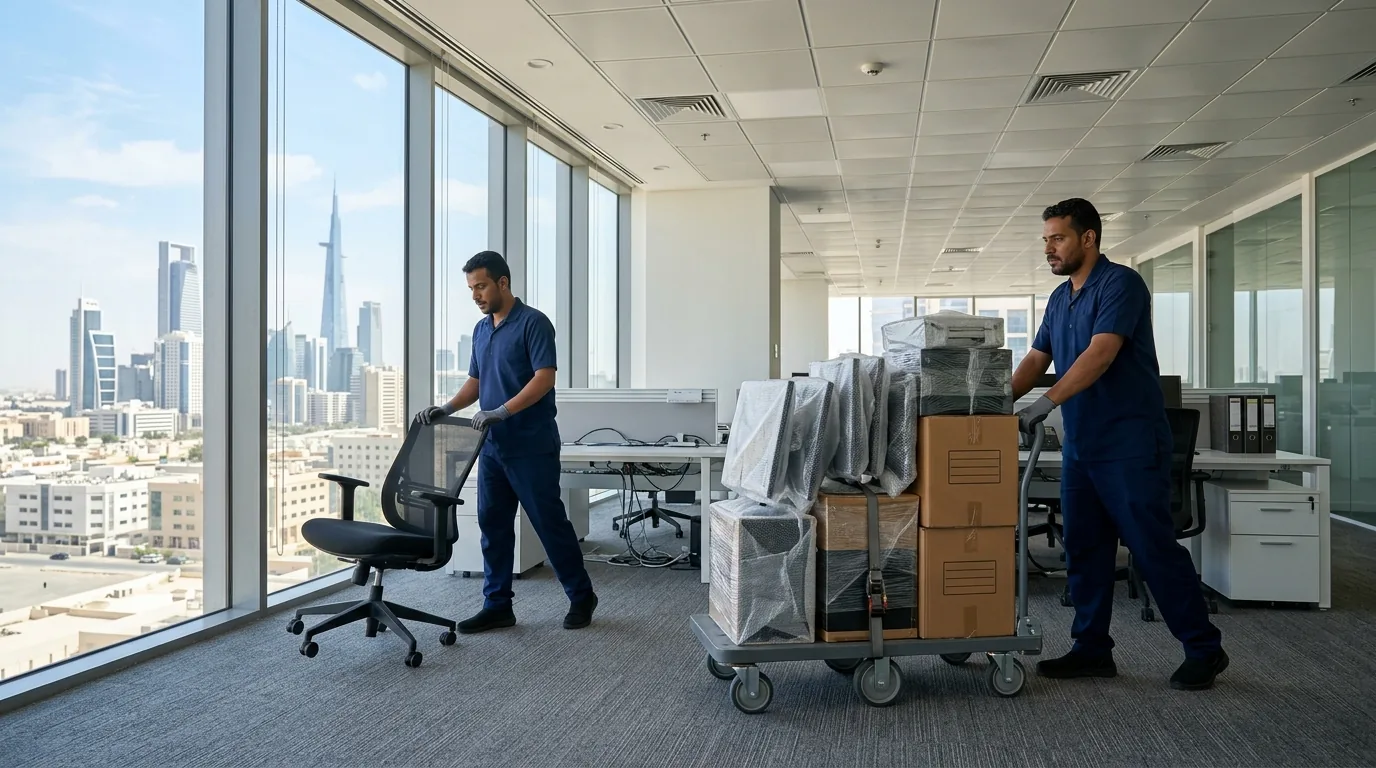
Moving a conference table in Jeddah is a different job from moving the rest of an office. Boardroom tables are often longer than corridors and lifts allow, the top may be one heavy slab or several matched panels, and many have built-in power boxes and cable trays. We measure the table and the route first, separate the base, beams and panels, wrap each part according to its material, transport it in a closed truck, and rebuild it level and aligned in the new meeting room.
Single-slab or multi-panel, wood, glass or marble: we plan the method from photos and measurements.
Why boardroom tables need their own plan
Most office furniture can be tilted through a doorway. A boardroom table often cannot. A three- or four-metre top may be longer than the corridor is wide at its turns, and a solid slab cannot flex or be leaned on its corner without risk. The route from the meeting room to the truck is usually the real challenge, more than the weight itself.
Modern conference tables also carry infrastructure: pop-up power modules, data ports, cable spines running down a leg into a floor box, sometimes mounted displays or microphones. Moving the table without disconnecting and protecting these parts properly can damage both the surface and the electrics.
That is why we treat a conference table as a small project on its own, even when it is part of a wider office move in Jeddah.
Types of conference tables we move
Solid wood or veneer on MDF: the most common in corporate offices. The surface scratches easily and the edges are the weakest point, especially on high-gloss lacquer. Glass tops: look light but are heavy, and must travel upright in a protective frame.
Marble, granite or engineered stone: the heaviest, often made of two or more slabs with a fine seam, needing enough handlers and proper carrying straps. Modular systems: several smaller tables joined into a U-shape, boat shape or large rectangle for training rooms and board meetings.
Folding or flip-top tables: common in multipurpose rooms; usually no dismantling, but the folding mechanism must be locked. Each type needs a different method, so we ask for a photo of the top and one of the underside before quoting.
Separating base, beams and top panels
Large conference tables usually sit on two or more pedestals joined by a steel or timber beam. Depending on the design we either lift the top off the base or turn the table on its side onto blankets, then remove the beams and legs.
Multi-panel tops are unbolted from underneath. Each panel is numbered by position, because panels that look identical are usually drilled to fit in one order only, and the wood grain or stone veining is matched across seams. More on our general approach is on the furniture dismantling and assembly page.
Bolts, connectors and levelling feet go into labelled bags taped to the part they came from, never into one shared bag.
Power modules, data ports and cable management
Many boardroom tables have a power or data module in the centre of the top, fed by cables running through a leg to a floor box. These must be disconnected at the source before anything moves, which normally means coordinating with your IT team or the building electrician.
Once disconnected, removable modules are taken out and the cut-out is covered with a fixed card panel so its edges are not chipped. Fixed modules get an extra layer of padding around the protrusion. Cable trays under the top are secured so they do not swing loose.
We recommend photographing the cabling before it is unplugged. It speeds up reconnection considerably at the new office.
Send a photo of the table top and underside and we will plan the dismantling: 0566300558.
Glass and stone tops: carried upright, framed and padded
Glass and stone should never be carried flat over any distance; the weight concentrates in the middle and can crack the slab. We carry panels upright on their long edge, with thick corner guards and moving blankets protecting every edge.
Large panels get a protective board or frame on both faces, and we make sure there are enough people to share the load evenly. In the truck, the slab is strapped upright against the side wall, away from anything that could shift.
Our wider methods for these materials are on the glass and marble moving page; here the focus is the top as part of a table that must be rebuilt precisely.
Measuring the table, corridors and lift
Before moving day we measure three things: the longest and heaviest part after dismantling, the narrowest point on the route from the meeting room to the exit, and the lift interior including height and the diagonal depth.
The diagonal matters. A panel that will not fit flat may fit angled. We repeat the same measurements at the new office, because a newer tower can still have a smaller goods lift or a meeting room door set at an awkward angle.
If the longest panel will not pass by any route, we discuss alternatives with you in advance: a different exit, a service lift, or a furniture crane.
Table: moving method by table type
This summary shows how the plan changes with material and design:
| Table type | Dismantling | Wrapping | Carrying | Watch point |
|---|---|---|---|---|
| Wood or veneer | Base, beams, sometimes top | Blankets, edge guards | Flat or angled | Edges and veneer |
| Glass top | Glass off the base | Frame, thick corners | Upright only | No pressure mid-panel |
| Marble or stone | Slabs and base apart | Blankets, boards | Upright, enough handlers | Seams between slabs |
| Modular system | Connectors between units | Each unit separately | By size | Order and numbering |
| Folding / flip-top | Usually none | Wrap, lock hinges | Standard | Folding mechanism |
This is a guide only. The final plan depends on photos or a survey, as many tables combine materials.
Wrapping layer by layer
The first layer is a soft sheet against the surface so that stretch film never touches lacquer or veneer directly. Then come heavy moving blankets, then foam or card guards on edges and corners, and finally stretch film pulled tight to hold everything in place without sticking to the finish.
Steel pedestals and legs are wrapped separately, because they are what most often scratches a panel when stored alongside it. High-gloss finishes need extra care: a grain of dust trapped under the wrap can leave a mark.
Details of our materials are on the furniture packing page.
Numbering parts and drawing a rebuild plan
Before dismantling we photograph the table from above and below and label every part: panels, pedestals, beams and power modules. A simple sketch on paper records where each number goes.
This is not a formality. Panels from large tables can be identical in shape yet differ in the position of fixing holes or the direction of the grain. Rebuilt in the wrong order, the seams show uneven gaps.
The sketch stays with the supervisor until the table is rebuilt, and you can keep a copy for your facilities records.
Office tower lifts: booking and protection
Office buildings in Jeddah have their own rules. Some require the service lift to be booked in advance, some restrict furniture moves to set hours, and some ask for the lift walls to be padded. We ask you about these requirements, or contact building management in coordination with you.
We cover the lift floor and walls with blankets and bring long panels in at a measured angle. If the lift is shared with other tenants, we schedule the move for a quieter period.
Knowing the building rules several days ahead avoids the crew arriving to find the lift booked or unavailable.
When a crane is the right answer
A crane is not our first choice, but it becomes necessary when a single-slab top is too long for the lift or the stairwell turns, and the meeting room has a window or balcony that can be opened to a suitable size.
A crane needs parking space at the building entrance and approval from building management, sometimes coordination with car park security as well. We decide whether it is needed during the survey and include it in the written quote if so.
Requirements and the process are explained on our furniture lifting crane page.
Chairs, credenzas and AV equipment
A conference table rarely moves alone. There are usually castor chairs, a credenza or sideboard, a display screen or mount, and a whiteboard. Chairs are wrapped individually with armrests protected, and numbered if a set must return to the same room.
Screens travel in their original boxes where available, or in foam and rigid card. Wall mounts are removed after their position is photographed. Video conferencing cameras, speakers and microphones should be disconnected by your IT team first.
Executive desks often move at the same time and have their own page, executive desk moving in Jeddah, while this page focuses on the meeting room and its table.
Not sure the longest panel fits the lift? Send the measurements and we will tell you before moving day.
Loading the closed truck and securing panels
Loading starts with heavy, stable parts such as pedestals. Panels are then strapped upright against the truck side, with blankets between each panel. Chairs and light cartons go in last and never on top of panels.
We use closed dyna trucks because lacquered and veneered surfaces are affected by sun and dust even on a short trip across Jeddah, and an enclosed body also limits exposure to humidity.
Before departure the supervisor checks that no panel moves when pushed by hand.
Rebuilding: position, level and seams
Before bringing parts in, we agree the table's position with you: distance from walls, orientation to the screen, and the location of any floor power box. Moving an assembled boardroom table afterwards is far harder than placing it correctly first.
Pedestals go in first and are levelled with adjustable feet or shims where the floor is uneven. Panels are then placed in numbered order and connectors tightened gradually until the seams close evenly.
Power modules are refitted and cable ends left ready for your IT team to reconnect.
Diagram: the six stages of a conference table move
Every table we move goes through the same sequence:
Skipping measurement is the most common cause of delay: the discovery that a panel will not pass then happens halfway down the corridor rather than days before.
What shapes the quote for a conference table
We do not publish a fixed price for conference tables because they vary so much. The quote depends on the top material and weight, number of panels, base complexity, built-in power, floor level and lift suitability, whether a crane is needed, the distance within Jeddah, and whether the table moves alone or as part of a larger relocation.
A single table is planned differently from a full department, where crew and equipment are shared across more work. For the wider picture, see our commercial office relocation cost estimate.
Send photos of the top and underside with the length, and we will reply with a written, itemised quote.
Checklist before moving day
Go through these points with your facilities or admin team:
- Measure the longest panel, narrowest door and corridor, and both lifts.
- Book the service lift and confirm permitted moving hours in both buildings.
- Agree a time with IT to disconnect and later reconnect power and AV.
- Empty credenzas and meeting room cabinets.
- Photograph the table and its cabling before dismantling.
- Mark the table's position on a simple floor sketch of the new room.
- Check the new room has no unfinished painting or flooring work.
- Arrange parking for the truck, or the crane if required.
- Name one person on your side to receive and confirm final placement.
The more of this is done in advance, the shorter and calmer the move.
Scenarios: tower office, villa office, training room
Multi-storey office tower: the lift and building rules are usually the main constraint, so we start with the diagonal lift measurement and a fixed time slot. Villa converted to offices: corridors are narrower and doors are standard residential size; the staircase may be the only route, so separating panels is essential.
Training room with modular tables: many similar units, where numbering matters more than dismantling so the same layout is recreated. Moving between floors in the same building: the distance is short, but wrapping is still needed, because scratches happen in corridors rather than on the road.
Crew size and equipment differ in each case, which is why we ask about the building before quoting.
Request a written quote for your conference table move within Jeddah on WhatsApp.
After-hours and weekend moves with minimal disruption
Moving a boardroom table on a working day means closing the room and possibly cancelling meetings. Many companies prefer Thursday evening, Friday or Saturday, provided the building allows it.
We schedule around building management's rules and aim to have the room ready for the first working day after the move. For broader planning, read our tips for a smooth weekend office move.
If the table is part of a full company relocation rather than a single room change, it fits better inside our office moving service so desks, storage and IT run on one timeline.
How to request a written quote
Call 0566300558 or send on WhatsApp: a photo of the table from above, a photo of the underside, length and width, top material, floor level in both buildings, lift availability, and the district in Jeddah for each location.
We review the details and send a written quote naming each task: dismantling, wrapping, closed-truck transport, rebuilding and a crane if needed. We are local movers in Jeddah working within the city and its districts only, Commercial Registration 4030592817.
If the table needs to wait while the new room is finished, we can store it dismantled and wrapped; see furniture storage in Jeddah.
Conference table moving in Jeddah: FAQ
In most cases yes, especially long or multi-panel tables. Dismantling protects the top and edges and makes it possible to pass doors and lifts.
The glass is separated from the base, edges are protected with thick corner guards and blankets, and it is carried and transported upright in a closed truck.
We recommend your IT team or the building electrician disconnects them; we then remove, protect, move and refit the modules ready for reconnection.
We first measure the lift diagonally. If it still will not fit, we discuss the stairs, a service lift, or a furniture crane where a suitable window or balcony exists.
Yes, subject to crew availability and building rules, so that the room is ready on the next working day.
Yes. Chairs are wrapped and numbered individually, and screens and mounts are moved after your IT team disconnects the equipment.
It depends on material, size, panels, access and distance. Send photos and measurements and we will reply with a written itemised quote.
Related pages
- Office moving in JeddahFull company relocations with desks and IT
- Executive desk movingHeavy individual desks rather than meeting tables
- Office relocation cost estimateFactors for pricing a whole office move
- Weekend office move tipsPlanning a move without losing work days
- Glass and marble movingDelicate surfaces beyond the office
- Library and archive movingFiles and books that leave with the room
- Furniture lifting craneWhen the top will not fit the lift
Send photos and measurements of your conference table on WhatsApp or call 0566300558 for a written dismantle, move and rebuild plan.