Wooden Bookcase Moving in Jeddah with Dismantling, Packing and Reassembly
A wooden bookcase is heavy, tall and full of small parts: adjustable shelves, sometimes glass doors, and books that weigh a lot. We move them in Jeddah with a plan that starts with emptying and dismantling in order and ends with reassembly and levelling in place.
Wooden bookcases · Emptying, dismantling and packing · Moving and reassembly in Jeddah
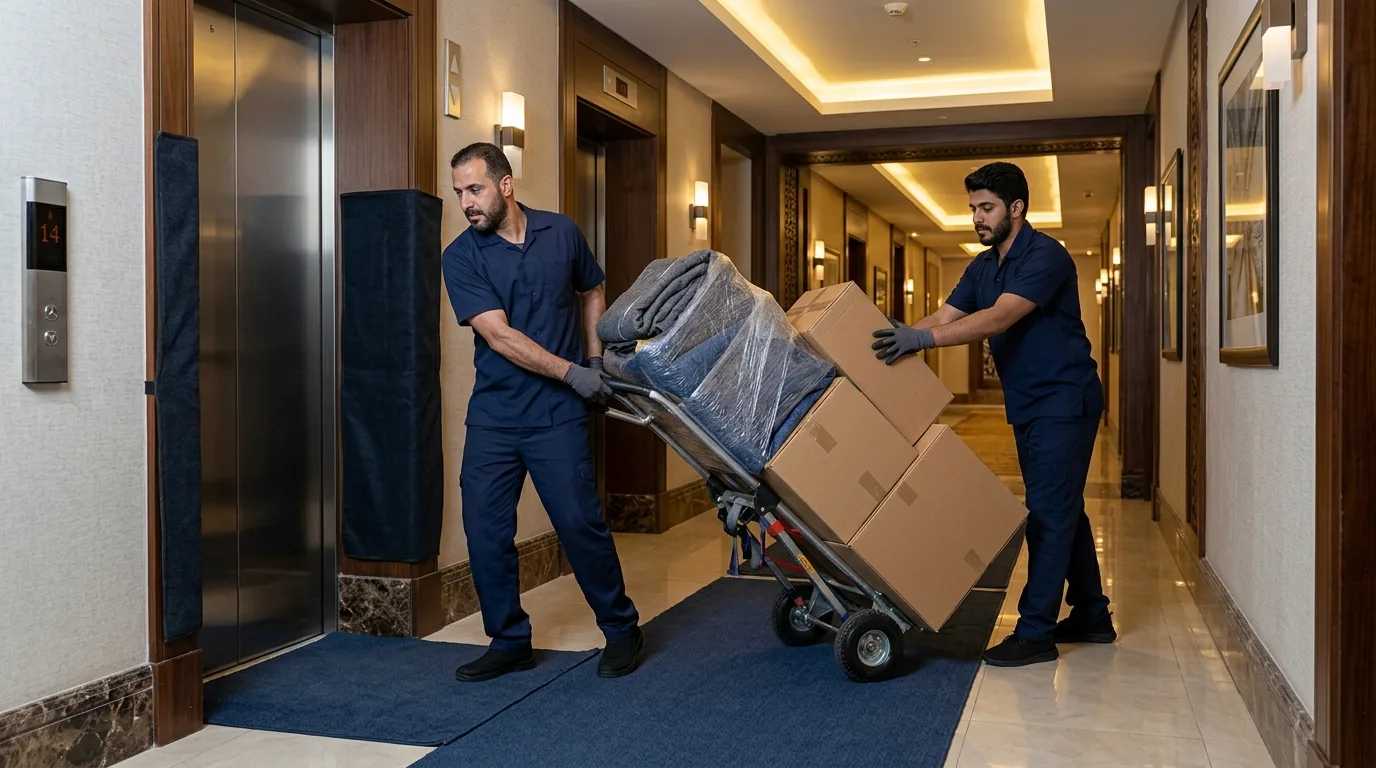
What makes a wooden bookcase hard to move
A bookcase is not one piece but a set: a long frame, shelves, perhaps glass or wooden doors, hinges and a thin back panel that breaks easily. Filled with books its weight doubles. Most damage in bookcase moves falls on the thin back, the glass and the shelf edges.
This page explains how we move wooden bookcases in Jeddah in clear steps that protect the piece and the people carrying it.
Step one: emptying the bookcase
Before anyone touches the frame, the bookcase is emptied. We advise packing books in small and medium cartons so a box never weighs more than can be carried safely, and numbering cartons in shelf order if you want to restore the arrangement. We photograph the bookcase before emptying so you can reorganise it easily. For the full picture of the service, see our movers in Jeddah overview.
We do not advise lifting a full bookcase even if it looks sturdy; it risks twisting the frame and injuring the carriers.
Assessing condition before dismantling
We check the frame, screws, hinges and feet, and see whether the bookcase is fixed with removable screws or with adhesive, and whether it can be taken apart without damage. Older glued units may travel as one piece after reinforcement, and some can only be partly dismantled.
We tell you what we see before starting and agree the best approach and its effect on time.
Send photos and dimensions of your bookcase on WhatsApp and we will plan the dismantling and move.
Removing shelves and doors
We take out removable shelves and number them, and remove glass or wooden doors and carry each separately. Shelf screws and supports go in a numbered bag attached to the piece, and we photograph their original position where they have set places.
Separating doors and shelves lightens the frame, protects fragile parts and makes doorways and stairs easier.
Handling glass
Glass doors are the most fragile part of a bookcase. We remove them, mark them clearly, wrap them in foam and bubble wrap with rigid edge protection, and carry them upright away from any pressure. If the glass is fixed in a timber frame we carry the whole door and protect it as one piece.
Tell us if any door is polished, decorated or old so we can protect it with extra care.
The thin back panel
Many bookcases have a thin hardboard back that is easily damaged by rubbing or pressure. We protect it with boards or thick cardboard and avoid placing the bookcase on a rough surface or dragging it on the floor. We carry it so the back is shielded from impact.
If the back is already damaged we record its state before the move so there is no later disagreement.
Packing according to the type of wood
Polished natural timber needs soft covers and foam against scratching, varnished bookcases need us to keep tape off the surface, and light flat-pack units need corner supports. We wrap each part according to its type and strap it before lifting.
We keep covers dry and clean so they do not leave marks on timber in Jeddah’s heat and humidity.
Carrying and stairs
Bookcases are long and hard to manage on tight turns. We measure the piece before lifting, plan the route, decide who leads and who watches corners, and use carrying straps where needed. We avoid tilting at angles that stress weak points.
If the piece will not pass a door or stair, we suggest dismantling or a lifting method instead of trial and error.
Arranging the bookcase in the vehicle
The bookcase travels in a stable position: upright leaning on the wall of the vehicle and strapped, or on its side if the back is protected. Heavy pieces go under and light ones above, and nothing heavy sits on glass doors or shelves.
We strap everything and fill gaps with covers so nothing moves on the road.
Unloading and reassembly
At the new place we agree where the bookcase goes, clean the floor, set the frame, fit shelves and doors, and level the unit with a spirit level. If it is tall or heavy we secure it to the wall where the wall allows, to avoid tipping, especially with children in the home.
Then we check hinges and doors close smoothly.
Need a carpenter with dismantling and reassembly? Call us and we will arrange one.
Wall-fixed and built-in bookcases
Some bookcases are fixed to the wall or integrated with the décor. These need a different assessment: removal may need a carpenter and wall repairs, and the unit may not be movable as one piece. Send clear photos of the fixing and we will decide with you whether it moves or stays.
If it is to be removed we record the wall condition first and explain what repairs may be needed.
Small home units versus large library walls
A three-shelf bookcase in a child’s room moves quickly with two people; a large wall unit in a majlis or executive office needs a bigger crew and tighter planning. We judge by dimensions, weight and number of parts.
That is why we ask for a photo, rough dimensions, and the number of shelves and doors.
Books: moving them without damage
Books are heavy, so use small cartons and pack them so they do not shift: large books flat and small ones upright, with valuable books wrapped separately. Do not fill a carton to the brim or use weak tape on the bottom.
If you have a rare collection, tell us so we can set it apart and carry it with care, or you can take it yourself.
A bookcase that needs a carpenter
If the unit needs repair or adjustment before moving, such as replacing feet, reinforcing a back or fixing a hinge, we can arrange a carpenter as part of the service. We say in the quote whether the carpenter is included and what exactly he will do.
Every repair is agreed beforehand to avoid surprises in cost.
Protecting floors and walls
Heavy bookcases leave marks if dragged. We place covers under the piece, support timber or marble floors while carrying, and protect door edges and walls in the corridor. At the new place we use felt or protective bases under the feet.
It helps to decide the position in advance so the piece is not moved twice.
How to prepare before the date
Send photos of the bookcase from front and side and of its details, tell us whether it has glass doors, how many shelves it has, the width of the door it will pass, and whether there is a lift. Pack the books in cartons before the crew arrives if you can.
This information makes the quote more accurate and shortens work time.
What affects the cost
Cost depends on the size, weight and number of parts, dismantling and reassembly, packing, floor and lift, distance, how many bookcases there are, whether you need a carpenter, and whether we are to empty and wrap the books. The clearer the details, the more accurate the quote.
We write a clear quote before the date and add no unagreed item.
Common mistakes in moving bookcases
The usual ones: lifting a loaded bookcase, dragging it on the floor, leaving glass in place, not fixing it to the wall after assembly, and ignoring the thin back. Add to that losing shelf screws when dismantling without organisation.
Most of these mistakes can be avoided with a little planning.
Example: a three-part wall bookcase
Take a wall bookcase in three sections with adjustable shelves and two glass doors. The crew photographs the original arrangement, empties the books into numbered cartons, removes doors and shelves, separates the three sections if designed for it, wraps each part and carries it to the vehicle in order. At the new place it reassembles the sections against the wall in the same order and levels them.
This is only an approximate example; every bookcase differs, so our quote relies on your photos and measurements more than on general examples.
Measurements we need before booking
We need the height, width and depth of the bookcase, the width of the door it leaves through, the width of stairs, hallways and turns, and the lift size if there is one. It also helps to measure the door of the new place, since some bookcases enter a room easily but not the building entrance.
If measuring is hard, a clear photo with an object of known size beside it helps us estimate.
Request a quote for your wooden bookcase now.
Old and second-hand bookcases
Old bookcases may have dry timber that splinters when dismantled, worn fixings and hidden earlier repairs. We handle them with more caution and agree with you that some pieces may not tolerate full dismantling and reassembly.
We record the condition with photos before starting so existing defects are known to everyone.
Floors: marble, carpet and timber
Floors decide how we move the piece: on marble we use covers and lift instead of dragging; on carpet we make sure the feet do not sink; on timber floors we use protective bases. In all cases we avoid sliding heavy pieces.
If you have a delicate floor, tell us so we prepare suitable protection.
Securing the bookcase after assembly to stop tipping
Tall bookcases can tip if an upper shelf is overloaded or a child climbs on it. We recommend fixing the top to the wall with fixings suited to the wall type and keeping heavy books on the lower shelves. We can do this on request if the wall allows.
If you rent, ask the landlord about permission to drill before the date.
How long does it take
Time depends on the size of the bookcase, the number of parts, its condition, whether it is full, the building and the distance. A small bookcase may take little time while a large wall unit takes much longer. We estimate after seeing photos.
We do not promise a fixed time before assessing, because correct dismantling matters more than speed.
Moving several bookcases in one day
In offices and homes with several bookcases we start with the largest and heaviest while the crew is fresh. We give each bookcase a number, a room and a destination, and number its shelves and doors the same so parts of two similar units never get mixed. Emptying all bookcases before the crew arrives saves working time.
If the bookcases look alike, clear numbered labels are the most important step to avoid reassembly errors.
Why move your bookcase with us
We treat a bookcase as a piece that needs a plan: emptying, assessment, dismantling, packing, carrying, assembly and levelling. We write a clear quote, speak to you directly and protect timber, glass and floors.
Send us photos of your bookcase now and we will reply with what suits its condition.
Common questions about moving wooden bookcases
Yes. Emptying protects the frame and the carriers, and we can pack books into cartons on request.
Yes, and we wrap glass separately and carry it upright.
We protect it with boards or thick cardboard and avoid any rubbing or pressure.
We assess each case from photos; a carpenter may be needed or it may not be movable in one piece.
Yes, we level the unit and secure it to the wall where possible.
Yes, taking dimensions, weight and building restrictions into account.
Send photos, dimensions, number of shelves and doors on WhatsApp, or call us.
Related pages
Moving a wooden bookcase? Send photos now and we will plan it with you.