Corner Sofa Packing in Jeddah: What We Wrap Each Part With, and in What Order
A sectional or corner sofa is really four to six separate pieces pretending to be one, and each piece needs a different wrap. This page describes the corner sofa packing service offered by Al Ostoura Movers in Jeddah: the materials we bring, the three-layer system we apply to every unit, how leather, velvet and linen are treated differently, what happens to recliner and sofa-bed mechanisms, and how everything is numbered so it goes back together in the new living room. Measuring doorways, splitting the units and loading the truck are covered on the separate corner sofa moving page. For a written quote, send photos on WhatsApp to 0566300558.
Commercial registration 4030592817 · Written contract before moving day · Photo and video quotes on WhatsApp · Genuine materials: moving blankets, kraft paper, bubble wrap, 5-ply cardboard, corner guards, stretch film
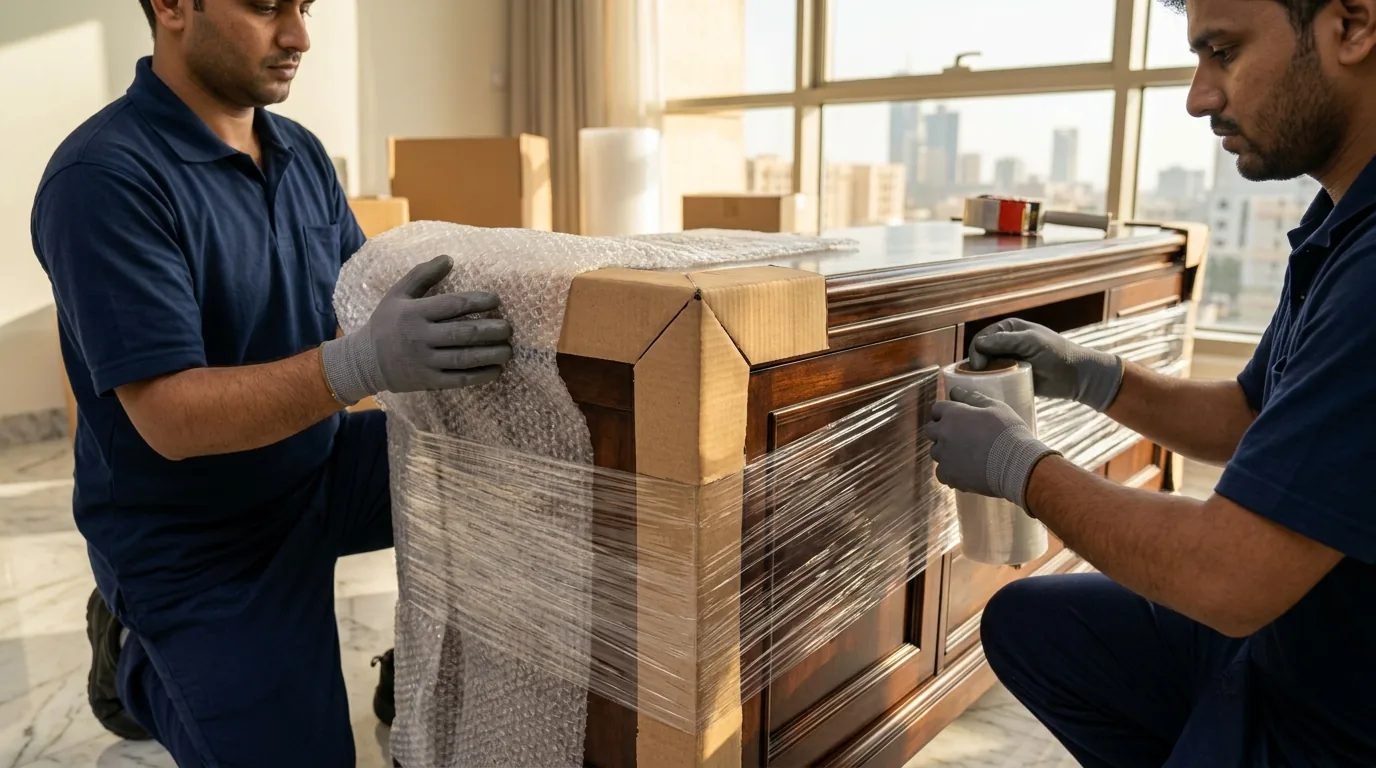
What this service covers, and what it deliberately leaves out
Corner sofa packing is the protective part of a move: choosing the right material for each component, applying layers in a fixed order, and securing them so nothing shifts while the piece is carried or driven. It covers loose cushions, fixed seats, the frame, the corner unit, legs, connecting brackets and any moving mechanism such as a recliner, a lift-up headrest or a storage drawer. Each component is treated as a numbered item on a list that the crew hands to you before anything leaves the room.
What this page does not cover is the route out of the apartment. Measuring the lift and stairwell, deciding how many units to split, and the loading sequence belong to our corner sofa moving page, which covers measuring, dismantling and loading. The two services are normally booked together, but we explain them separately because the mistakes are different: a loading error dents a wall, a packing error ruins the upholstery. Packing can also be booked on its own, for storage or before painters arrive, as described further down.
Why a sectional is harder to wrap than a three-seater
A standard three-seater is one rigid box with two exposed ends. A modern L-shaped or U-shaped sectional is usually three to six modules joined by metal clips or interlocking plates, and once separated every module has six visible edges and at least two hard corners. The side faces that were hidden against the neighbouring module are often covered in cheaper fabric or bare particle board that scratches at a touch and soaks up humidity, so the number of surfaces needing protection roughly doubles.
The corner module itself is deeper and heavier than the straight modules and its centre of gravity sits toward the back corner, which is why wraps that stay put on a straight unit slide off a corner unit halfway down the stairs. Add a recliner motor, a pull-out bed or USB charging ports and you have cables, hinges and springs that must be locked before, not after, the blankets go on. That is why we keep a dedicated material list and work order for sectionals instead of applying the generic furniture packing service.
The materials we bring and which part each one is for
Five materials do most of the work: kraft paper or non-woven fabric as a barrier layer, thick cotton moving blankets for upholstery, large-bubble wrap for hard surfaces, five-ply corrugated cardboard for edges and bases, and stretch film for the outer binding only. Around them we use foam or cardboard corner guards, paper tape that never touches fabric, and labelled zip bags for screws and clips. The table shows what goes where and why.
| Material | Used on | Why |
|---|---|---|
| Kraft paper / non-woven fabric | Leather and velvet, directly on the surface | Barrier: stops plastic sticking and moisture condensing |
| Cotton moving blanket | Cushions, seats, upholstered frame | Absorbs knocks, prevents rubbing and scuffs |
| Large-bubble wrap | Wooden legs, exposed arms, back panel | Protects against point impacts |
| 5-ply corrugated cardboard | Lower edges, corner unit base, arm tops | Spreads pressure during carrying and stacking |
| Stretch film | Outer layer only | Binds the layers, keeps dust out |
| Labelled bags + paper tape | Screws, clips, hex keys | No lost hardware at reassembly |
We avoid thin single-use plastic sofa covers that tear on the first edge, and we never put packing tape or electrical tape on fabric or leather because the adhesive residue does not come off. A fuller comparison of protective materials and how they affect your quote is in bubble wrap vs corrugated cardboard.
The order of work: small parts first, frame last
We always wrap what can get lost first, then what can get dirty, then the big frame. Loose parts left on the floor while the crew works on the frame get stepped on or forgotten, and cushions wrapped after the frame compete for floor space in a room that is already full. The sequence below is the one our crews follow on every sectional, whether in a villa in Al Murjan or a fifth-floor apartment in Al Nahdah.
- Photograph the assembled sofa from four sides to record its condition and the module layout.
- Remove loose cushions, bolsters and adjustable headrests and group them in one spot.
- Unscrew removable legs; bag the bolts and tape the bag to the underside of the same module.
- Lock every mechanism in the closed position with fabric strapping; coil and secure cables.
- Wrap cushions, then fixed seats, then arms and backs, then the corner unit.
- Fit corner guards and cardboard strips on the lower edges.
- Bind with stretch film, write the module number and an up-arrow on two faces.
The same order applies whether the sofa moves across Jeddah the same afternoon or spends two months in furniture storage. For storage we change only the outer layer, explained in its own section below.
Send a front and back photo of your sectional on WhatsApp 0566300558 and we will reply with a written quote listing the modules and materials.
Loose cushions and bolsters
Loose cushions are the easiest part to wrap and the easiest to ruin, because they are light and end up on the pavement or the truck floor while heavier items are handled. Each cushion goes into a cotton or non-woven cover, never straight into stretch film: soft weaves hold the pressure lines of a tight wrap for days. Cushions with zip-off covers stay in their covers so the filling does not bunch into one corner.
The cushions of each module are then bundled loosely together and marked with that module number, because corner-unit cushions are usually wider than straight-unit cushions and look identical once they are out of place. Feather and microfibre fillings are never folded or compressed to save space; recovering their loft takes days of airing. Adjustable headrests are lowered to their lowest position and wrapped with the module, not separately.
Fixed seats and integrated foam
Many sectionals sold in Jeddah have foam seats glued or stapled to the frame, and those seats take most of the load when a module is tipped on its side or something is stacked on it in the truck. We lay a non-woven barrier first, then a cotton blanket that covers the seat and wraps under the front edge, because the front edge is what rubs on every door frame. The blanket is held by a fabric strap around the whole module, never by adhesive.
Where the seat sits on coil springs or elastic webbing, we avoid any tight vertical strapping that would compress the foam for hours and use horizontal straps only to keep the blanket in place. The line where seat meets arm collects grit and is exactly where movers grip the piece, so a strip of cardboard goes under the blanket there. The seat arrives without pressure creases and without hand marks.
The frame: back, arms and the underside
The frame is what the movers actually hold, so its layers must survive a firm grip and contact with door frames. We cover back and arms with one continuous blanket where possible, because the seam between two blankets is where a scratch gets through. Arms with exposed wood or metal fronts get bubble wrap before the blanket, so plastic touches wood and not fabric.
The underside is usually particle board or a cheap mesh and it is what gets dragged if a mover tires on the stairs, so it is covered with a five-ply cardboard sheet strapped on from below only. Front frame legs that cannot be removed get a long foam corner guard. We leave the two lifting points on each side uncovered and marked with coloured tape so nobody picks the module up by a headrest or a fixed cushion.
The corner unit: heaviest piece, most likely to slip its wrap
The corner module is deeper on both sides than the straight modules, has three visible faces instead of two, and carries its weight toward the back corner. It is therefore not wrapped in the usual circular pattern but in an X: one blanket covers the front face and seat and ties off at the back, a second covers both sides and crosses the first at the corner. The outer back corner gets a double corner guard because it is the first thing to hit a wall when the piece turns.
Because the corner unit is carried by two people on its own, we add two fabric lifting straps under the outer layer, exiting through two deliberate openings in the stretch film, so nobody has to tear the wrap to get a grip. If the corner unit houses a storage drawer or a bed mechanism, that is locked first as described in the mechanisms section. The corner unit is last onto the truck and first off, and its position inside the box is described further down.
Legs, feet, clips and bolts
Tapered wooden legs and plated metal feet are the parts most often lost or chipped, so we remove them whenever a proper key fits, never by force. Each leg is wrapped individually in bubble wrap, the legs of one module are bundled, and their bolts and washers go into a numbered bag taped to that module's underside with paper tape. Legs that cannot be removed get foam corner guards and a top-only band of stretch film.
Connecting hardware comes in two kinds: fixed metal brackets that stay on the frame, and removable plates or hooks. Fixed brackets are covered with a small cardboard pad before wrapping because they are sharp enough to slice a blanket and gouge a wall; removable connectors are bagged with the numbers of both modules they join. We also photograph each bracket before removal, because some sectionals use identical-looking connectors that face in opposite directions.
Recliners, sofa beds and powered seats
Recliner modules contain heavy hinges and a tensioned spring; if the mechanism moves during a carry it can snap open, injure a mover or break the arm. We lock it closed with a wide fabric strap wound front-to-back twice around the module, then lay the blanket over the strap. Sofa-bed mechanisms are secured with their own latch where one exists, otherwise with the same strapping, and the inner mattress comes out and is wrapped separately because it adds weight and gets in the way of the lift points.
Powered modules with recliner motors, USB ports or LED strips are unplugged; the cable and plug are coiled and taped to the underside away from any edge that could pinch them. Side control buttons get a small foam pad so they are not pressed under the film. The outer layer is marked MECHANISM with an up-arrow so the module is never laid on its back in the truck, which is the leading cause of motors being out of alignment after a move.
Fabric by fabric: velvet, linen, chenille and jacquard
Velvet records pressure along the pile, so nothing tight touches it directly; it gets a loose non-woven layer before the blanket and is kept out of direct sun in the truck, because heat sets pressure marks. Linen and coarse cotton do not scratch but attract dust quickly, so their first layer is about keeping out the fine grit that circulates inside a closed truck body on a Jeddah afternoon.
Chenille and jacquard have raised threads that snag on a bare cardboard edge or a piece of tape, so every cardboard edge is folded inward or wrapped before it meets the fabric. Light-coloured upholstery gets a white barrier layer rather than a dark blanket laid directly on it, since some blankets transfer dye when damp. The layer logic for delicate surfaces in general is in our bubble wrap layering guide.
Real and faux leather: why plastic never touches the hide
Leather breathes and reacts to heat, and Jeddah is hot and humid for most of the year. Stretch film applied directly to leather creates condensation within hours, leaving pale blooms or a sticky finish; faux leather is worse, because its top coating bonds to warm plastic and peels when the film is removed. The first layer on any leather is kraft paper or cotton, then a blanket, then film on the outside only.
We also avoid pulling blankets tight across stitched seams, because leather expands in a hot truck and contracts in an air-conditioned living room and a stressed seam can show afterwards. Leather arms with sharp edges get a corner guard over the paper, not under it. The full treatment, including how to handle scuffs discovered on arrival, is in protecting leather couches from humidity and scratches; it applies to a leather sectional word for word, with extra attention to the side faces exposed when the modules are split.
Leather or velvet sectional and worried about the summer heat? Call 0566300558 and we will plan the barrier layer for your fabric.
The three-layer rule on every surface
Whatever the material, the principle is the same: three layers per surface, each with one job. The first is a barrier that touches the surface and stops plastic sticking or moisture condensing. The second is protection that absorbs knocks and prevents abrasion. The third is binding that holds everything in place and keeps dust out. When two layers are merged into one, as happens when a sofa is simply shrink-wrapped, two of the three jobs are left undone.
Note that tape appears nowhere inside the layers; it is used only on the stretch film or on cardboard. Which tapes are acceptable on that outer layer, and why reinforced tape is not always better, is covered in packaging tape types.
Corner guards and edge strips: exactly where they go
A sectional gets damaged at its corners before anywhere else, because the corner is the first point of contact with a door frame, a stairwell wall or a lift door. Each module has four hard lower corners that take L-shaped foam guards and two upper corners on the backrest that take folded cardboard, since foam slides off upholstered fabric. The corner module gets guards on its outer back corner at both top and bottom.
Long arm edges get a U-folded cardboard strip under the blanket when the arm is wood or metal and over the blanket when it is upholstered. The front lower edge of the seat, which touches the ground every time a module is set down to rest, gets a five-ply strip the full width of the module. These same guards are what protect your landlord's walls and door frames, a topic covered in protecting walls, door frames and elevators.
Numbering and labelling so the sofa goes back together
A four-module sectional produces at least twelve wrapped items: the modules, cushion bundles, leg bundles, hardware bags and perhaps an inner mattress. Without clear labels, reassembly in the new flat loses half an hour to matching cushions to modules, and a module can be fitted facing the wrong way. Our crew lead checks the list below before the first piece is lifted.
- Module number counted right to left as seen from the front, written on two faces of the outer wrap.
- An up-arrow and the words DO NOT TIP on any module with a mechanism.
- The module number repeated on its cushion bundle, leg bundle and hardware bag.
- Connector positions sketched on one sheet handed to you with the phone photos.
- Lift points marked with coloured tape on both sides of every module.
- An extra marker on any module carrying a power cable.
The list is photographed and sent to you on WhatsApp before loading, so there is a shared record if anything looks different on arrival. Linking these labels to room placement in the new home is explained in colour-coding boxes for room placement.
Heat and humidity in Jeddah: what changes in summer
Relative humidity in Jeddah stays high for most of the year, and a closed truck body at midday becomes very hot, so any plastic touching leather or dark fabric turns into a small condensation chamber. The barrier layer matters more in summer, and non-woven fabric is preferred over paper because it does not soften when damp. Blankets must be completely dry before use; a blanket still damp from a previous job transfers its smell and stains.
We also avoid leaving wrapped modules on the pavement in direct sun for more than a few minutes, since dark or coloured stretch film heats whatever is under it quickly. On dusty days the legs and metal connectors get an extra turn of clear film so grit does not reach their joints. More on how heat affects wood, glue and fabric during a move is in moving furniture in Jeddah heat and humidity.
Packing for storage versus packing for a same-day move
If the sofa is going from one home to another the same day, the standard three layers are enough, because it will be wrapped for hours. If it is going into storage for weeks or months, two things change: the outer stretch film is replaced by a breathable fabric cover or left open at the bottom, and cushions are stored separately from the modules rather than bundled with them, so they do not trap heat. Leather in storage needs more airflow than fabric.
Stored modules are also raised off the floor on timber or thick cardboard and are never stacked on each other, however well wrapped, because foam loses height under a constant load over weeks. If you are leaving Jeddah for a few months, the combined service is described at temporary storage during travel; tell us at booking that the packing is for storage so we bring the right outer covers.
Where wrapped modules sit inside the dyna truck
This page does not describe the full loading plan, but the position of a wrapped sofa inside the truck is part of protecting the wrap itself. Straight modules travel upright on their bases, never on their backs, with their rear faces against the truck wall and a blanket between each pair even though both are wrapped. The corner module is placed into a corner of the truck body so two of its faces rest against two walls, which is the one position it cannot slide from.
Nothing is stacked on top of the sofa, however light, and no mirror or glass is leaned against it; it gets its own space secured with a single strap across the frame rather than across the cushions. How blankets and straps work inside a closed dyna truck is in the function of moving blankets in dyna trucks, while the loading sequence for the whole household stays on the sister moving page.
Need packing only, before painting or storage? Message 0566300558 on WhatsApp for a written quote, same day subject to availability.
Unwrapping on arrival, common mistakes, and packing-only bookings
Unwrapping runs in reverse: outer film cut with a plastic safety cutter, never a metal blade, then blanket, then barrier, with each module inspected before the next is opened. We start with the corner unit because it fixes the sofa's position in the room, then the modules in numbered order, fitting legs before each module is set down so it is not lifted twice. Cushions are opened last and given an hour in room air before being placed, and any pressure mark on velvet is lifted by brushing with the pile or with light steam from a distance. Check each piece as it is unwrapped using the furniture inspection checklist so notes are made while the crew is present.
The mistakes we see most often in Jeddah are shrink-wrapping the whole assembled sofa with no barrier layer, taping directly onto fabric or leather, and leaving a recliner unlocked so it springs open on the stairs. Less obvious ones include wrapping legs with the module instead of removing them, laying a dark blanket on pale fabric on a humid day, and stacking cushions under modules instead of beside them. Packing can also be booked without a move: before painters or renovation work, as explained at moving during home renovation, before storage, or when you are hiring your own truck and want the sofa wrapped professionally. For the whole flat rather than just the sofa, see move-out packing and protection.
What sets the price, how the written quote works, and where we serve
There are no figures on this page because the price depends on a short list of factors we can name precisely: the number of modules, whether there are recliner, bed or powered mechanisms, the upholstery type (leather and velvet consume more barrier material), whether the wrap is for a same-day move or for storage, and whether packing is booked alone or as part of a full move. The quantity of blankets and cardboard follows from the size of the piece, which we judge from your photos. To get a written quote, WhatsApp 0566300558 with a front and a back photo of the sofa, one close-up of the join between two modules, and a note on any mechanism; the quote lists modules and materials and becomes a written contract before the working day that defines liability for damage caused by the move. For related pricing logic see full apartment packing cost and packaging materials cost comparison.
We pack sectionals across Jeddah: large family apartments in Al Naeem, Al Nahdah and Al Salhiya in the north, older walk-up buildings with tight entrances in Al Kandarah and Al Sharafiya in the centre, and villas in Al Murjan, Al Shati and Obhur on the coast. In older buildings the corner guards and underside cardboard matter most because door frames and stair turns are close together; in villas the barrier layer matters most because the sofa crosses an open courtyard in the sun. The complete list of districts is at Jeddah neighbourhoods we serve. Sofa packing is most often booked as part of majlis and living room moving or alongside a tight lift, as in moving a sofa through a small elevator. You can browse everything else we do as movers in Jeddah from the homepage, or call 0566300558 to discuss your sofa directly.
Corner sofa packing in Jeddah: frequently asked questions
Technically yes, but we advise against it. An assembled sectional is a heavy piece with many corners that will not fit through most Jeddah apartment doors, and wraps slide off it. Splitting the modules exposes side faces that need protection, but it makes each unit liftable and tightly wrappable. We only leave a sectional whole when it is a single manufactured piece with no connectors.
Because Jeddah heat and humidity create condensation under plastic within hours, leaving pale blooms on real leather and bonding the top coat of faux leather to the film. We put kraft paper or cotton on first, then a blanket, and use stretch film only as the outer binding layer.
It is locked closed with a wide fabric strap wound twice around the module before the blanket goes on; powered units are unplugged and the cable is taped to the underside. The outer wrap is marked MECHANISM with an up-arrow so the module is never laid on its back. This prevents the mechanism springing open mid-carry, the main cause of broken arms.
They are useful for cushions and legs only. Factory packaging was designed for one trip on a pallet inside a container, not for a hand carry down a stairwell, and the cardboard weakens in storage. We use whatever is still sound as an extra layer, but blankets, a barrier layer and corner guards do the real work.
It depends on the upholstery and mechanisms, but a standard four-module fabric sectional without mechanisms is usually wrapped in under an hour by two movers; leather, velvet and powered units take longer. We state the expected time in the written quote after seeing your photos, and on the day packing is completed before any loading begins.
Yes. For storage we replace the outer stretch film with a breathable cover or leave it open at the bottom, separate the cushions from the modules, raise the modules off the floor and never stack them. Tell us at booking that the packing is for storage so we bring the right materials.
WhatsApp 0566300558 with a front and back photo of the sofa and a close-up of the join between two modules, and tell us the upholstery type, any mechanism, and whether you need packing alone or as part of a move. We reply with an itemised written quote that becomes a written contract before the working day.
Related pages
- Corner sofa moving in Jeddah: measuring, dismantling, loadingThe sister page covering the route out, splitting and the truck plan
- Furniture packing in JeddahWhole-home packing service
- Majlis and living room movingMoving the sectional as part of the whole lounge
- Protecting leather couches from humidity and scratchesHands-on guide for real and faux leather
- Bubble wrap layering guideLayer order for delicate surfaces
- Bubble wrap vs corrugated cardboardWhen to use each material and the effect on cost
- Furniture storage in JeddahKeeping a wrapped sofa for weeks or months
- Moving a sofa through a small elevatorWhen the lift is tight
Send photos of your corner sofa on WhatsApp 0566300558 or call us, and we will reply with a written quote naming the materials and the number of modules before we arrive.