Large Wall Mirror Moving in Jeddah
A large mirror is one of the easiest things to break in a move, and usually not on the road. It breaks when it comes off the wall, when it is carried flat, or when it is packed badly in the truck. We plan mirror moves in Jeddah from removal to rehanging, with edges and frames protected the whole way.
Wall, floor and entrance mirrors · removal, upright transport, rehanging
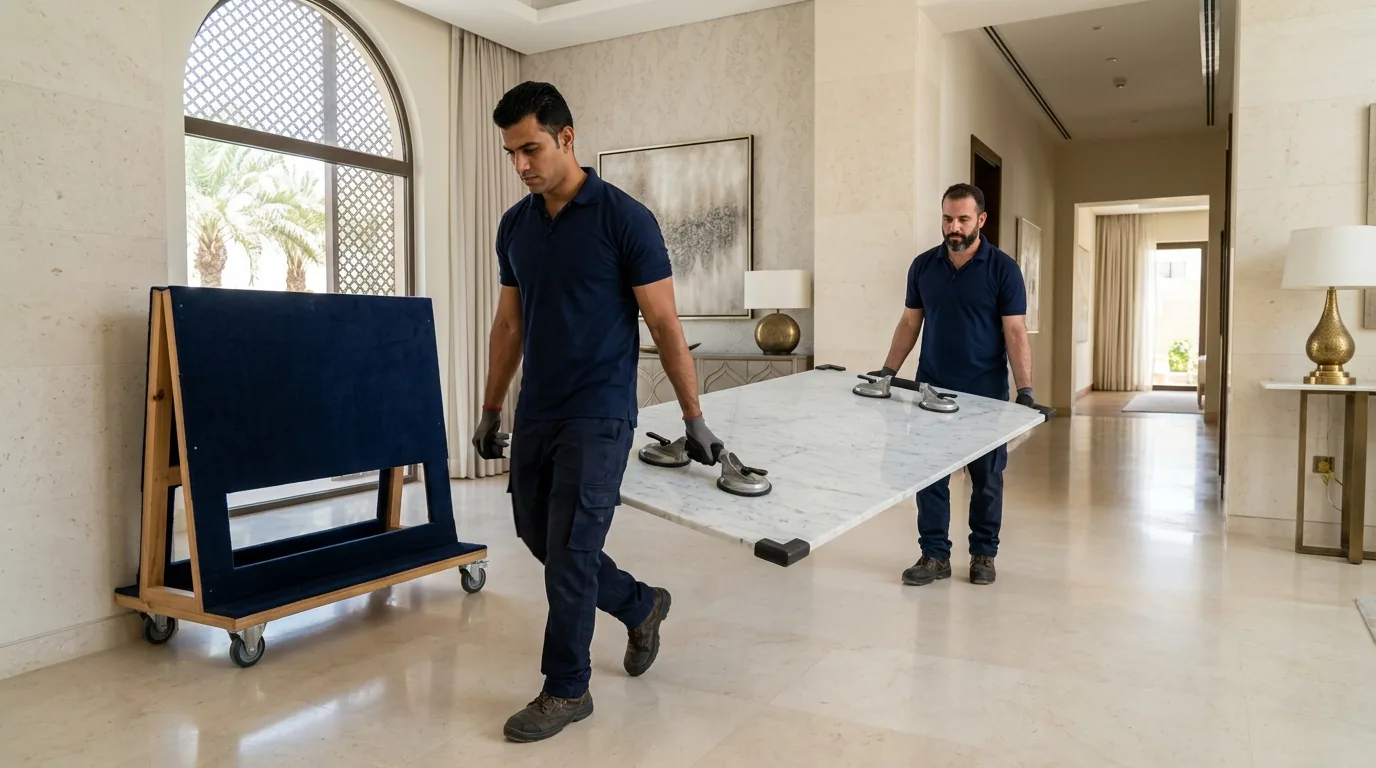
Why big mirrors need their own plan
A mirror is a sheet of glass with a coating on the back, heavy for its thickness and spread over a wide area. Pressure on the middle, a knock on a corner, or lying it flat under other items can crack it, sometimes with a hairline that only shows later. The bigger the mirror, the bigger the risk, because even slight flexing while carrying can break it. So we plan each one: how it comes off the wall, how many people carry it, which route it takes out, and where it rides in the truck.
Mirror types we move
| Type | What matters in transit |
|---|---|
| Framed wall mirror (wood or metal) | Frame protects edges but adds weight |
| Frameless mirror on clips | Exposed edges need strong corner guards |
| Mirror glued to the wall | Usually not worth removing; glue can break it |
| Full-length floor mirror | Length makes stairs and lifts awkward |
| Dresser or wardrobe mirror | Detached and moved separately |
| Ornate or antique entrance mirror | Fragile frame may need a wooden crate |
Step one: check how it is fixed
Before touching the mirror we find out how it hangs: a wire on a hook, metal hangers screwed to the wall, edge clips, or adhesive. Wire or hanger mirrors are lifted straight up and then out by two people. Clip-mounted mirrors are supported by two movers while the bottom clips are undone first. Fully glued mirrors are a different case: we tell you honestly that removing them may break them and suggest leaving them or calling a glazier.
WhatsApp a photo and the size of your mirror, and we will tell you the right removal and protection method.
Always carried upright
The golden rule is that a mirror is carried and transported standing on its long edge, never flat. Carried flat, the weight of the glass bears on its centre and it flexes. Large mirrors are carried by at least two movers, one on each side, wearing grip gloves. Very large ones need three, with one person guiding through doors and turns and watching the corners.
Protection before lifting
Thick cardboard or plastic corner guards go on all four corners, the weakest points. The face is covered with bubble wrap or a sheet of board, corrugated card goes on both sides, and everything is taped without tape touching the glass. Some movers tape an X across the glass; it does not prevent breakage but limits scattering if it happens, and we use it on some frameless mirrors. Full packing layers are covered in our glass and mirror packing guide.
When a wooden crate makes sense
A custom wooden crate is the highest level of protection. We suggest it for antique or ornate mirrors with fragile frames, very large mirrors going a long distance or into storage, and mirrors of special value that cannot be replaced. For ordinary mirrors, layered wrapping and correct upright transport are enough. The quote shows the difference so you can decide.
Doors, stairs and lifts
A long mirror does not bend or come apart, so its route from wall to truck must be planned. We measure doors, stair turns and the lift's height and depth. A mirror that will not stand upright in the lift goes down the stairs, with movers above and below easing the corners round. We never twist a mirror sharply at turns, as torsion stresses the glass.
Where it rides in the truck
Mirrors stand on edge against the truck side or between two flat, stable items such as a wrapped wardrobe back or a mattress, and are strapped in place. Nothing heavy goes in front of or on top of them that could shift when braking. Several mirrors stand side by side with thick card between them. They are loaded last, near the doors, so they come off first.
Rehanging at the new home
Rehanging needs to account for the wall: concrete, block or plasterboard. Plasterboard will not hold a heavy mirror on ordinary nails and needs proper fixings or attachment to the studs behind it. We level with a spirit level and check the hangers take the weight before letting go. If you have not decided where it goes, we leave it safely leaning against a wall on a soft base.
Need the mirror rehung at your new home? Call us.
The process from start to finish
- Photo, size and fixing method of the mirror.
- Measuring the route to the truck.
- Choosing crew size and protection or crate.
- Removing it from the wall with two people supporting it.
- Corner guards and layered wrapping.
- Upright carry to the truck.
- Strapped upright in place.
- First off at the new home and rehung.
Example: a two-metre entrance mirror on the fourth floor
A customer on a fourth floor had a framed entrance mirror nearly two metres tall that would not fit the lift standing up. From the photo and size we planned a three-person stair carry. We took it off its hangers, rested it on a soft base, fitted corners and corrugated card, and brought it down upright with one mover guiding at each turn. In the truck it stood beside a wrapped wardrobe back, came off first, and was hung once the right wall was chosen.
Heavy framed mirrors: mind the frame
With heavy wood or metal frames, much of the weight is in the frame. Lifting by the top rail alone can separate the frame from the glass or open its corners. We lift from the sides and bottom and check the frame is sound and the back clips holding the glass are secure. If a frame is loose, we tape it temporarily and tell you before moving it.
Villas with oversized mirrors
Large villas often have huge mirrors in entrances, majlis rooms and dressing rooms, some almost wall-height. They may only pass through the main entrance, not internal doors. We send more movers and sometimes a flat-panel trolley. If a mirror will not pass any door, we discuss a balcony hoist with you.
What affects the cost
- Size and weight.
- Framed or frameless, and frame type.
- Fixing method and difficulty of removal.
- Floor level, lift and stairs.
- Whether a wooden crate is needed.
- Rehanging and wall type at the new home.
As part of a full home move it is a line in the quote; on its own it is priced by time, crew and materials.
Request a quote to move your mirror or mirrors safely.
Mistakes that break mirrors
- Carrying it flat between two people.
- Laying it flat in the truck with items on top.
- Skipping corner protection.
- Pulling it off the wall before checking how it is fixed.
- Hanging it on plasterboard with an ordinary nail.
- Standing it directly on a hard floor with no soft base.
How this page differs from our other glass pages
This page is about moving large mirrors: removal, carrying, loading, securing and rehanging. Packing materials and layers for glass and crystal are covered in our packing guide, and our glass and marble moving service covers glass tables and marble tops. They can all be combined in one move.
Several mirrors in one home
Homes with many mirrors, from entrance to dressers and wardrobes, need numbering: each mirror gets a code for its original and new location. They stand together in the truck with card dividers, largest and heaviest first, and a small mirror is never sandwiched between two large ones without a divider.
Storing a mirror
If a mirror will be stored before hanging, it should never lie flat or under other things. It stands on its long edge on a timber or thick card base against a wall or fixed rack, away from walkways. In warehouses we prefer a crate or two fixed boards on either side, with clear fragile and this-way-up labels.
How to prepare
- Move furniture away from the mirror wall.
- Photograph the mirror from the front and side so we can see thickness and fixing.
- Measure height and width roughly.
- Tell us if it is antique or of special value.
- Decide its new location and wall type if you know it.
Moving large wall mirrors: FAQs
Yes. We remove them according to how they are fixed and rehang and level them at the new home.
We usually advise against it because the adhesive can break the glass. We explain the risk and suggest alternatives.
No. Crates are for antique, oversized, long-distance or stored mirrors. Most mirrors are fine with layered wrapping and upright transport.
At least two; three for very large mirrors or routes with stairs and tight turns.
Yes, with proper fixings or attachment to the studs. We assess the wall before hanging.
Yes, one or several mirrors can be a standalone job.
Send a photo, the size, floor level and destination by WhatsApp.
Related pages
- Glass and marble moving in JeddahParent service for glass items
- Packing glass, mirrors and crystalPacking layers in detail
- Custom timber cratesWhen a crate is worth it
- Furniture hoist in JeddahFor items that will not pass the stairs
- Bedroom assembly in MishrifahDetaching dresser and wardrobe mirrors
- Luxury and antique furniture movingFor antique-framed mirrors
Have a large mirror to move safely? Send a photo now.